 Pramaan

8 + 4 = ? + 5. What would your child write?
Many children read the equals sign as "the answer goes here". Two studies show how long that idea lasts, and why it matters when algebra arrives.
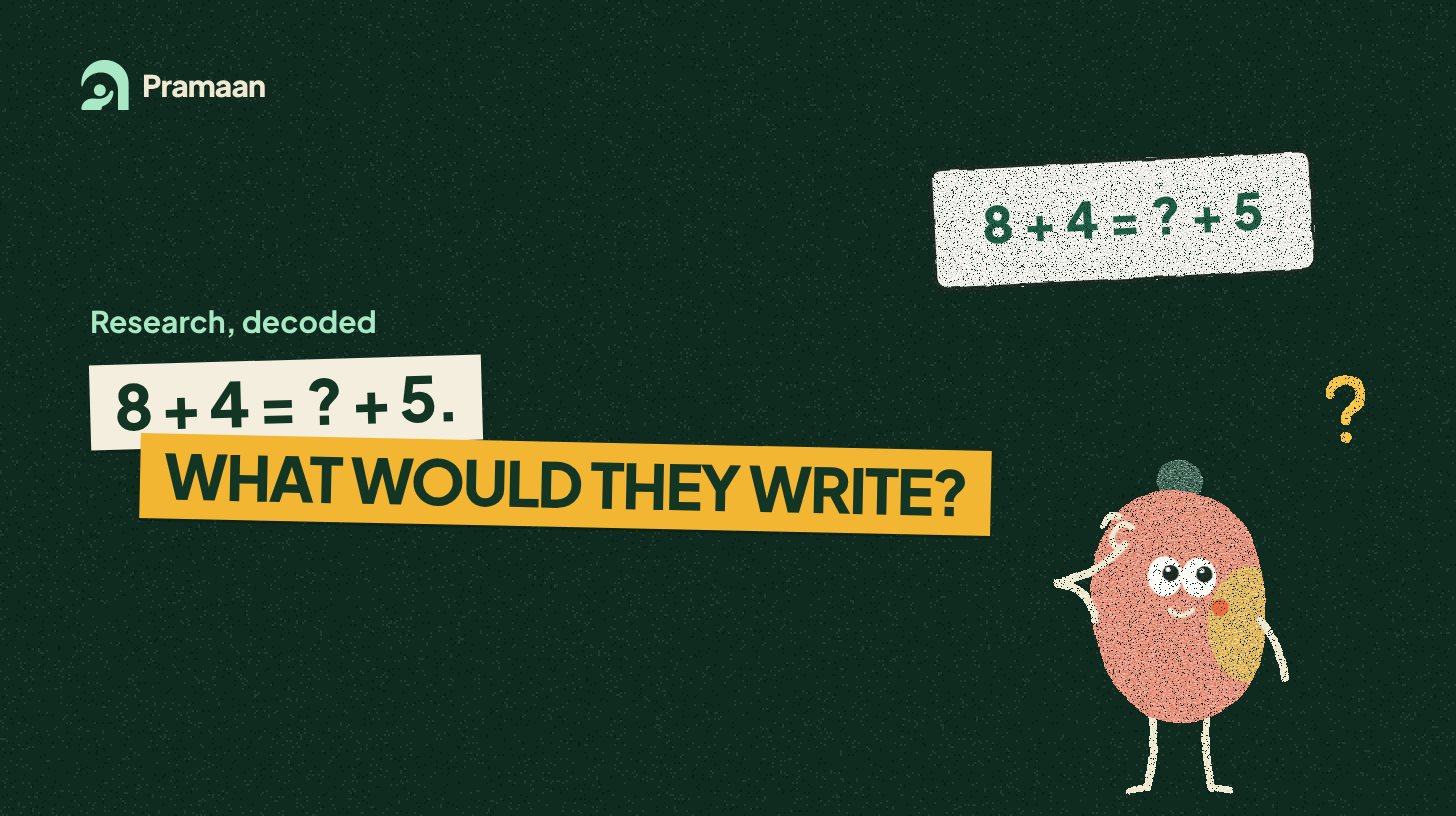
Write this on a piece of paper and hand it to your child: 8 + 4 = __ + 5. Ask them to fill in the blank.
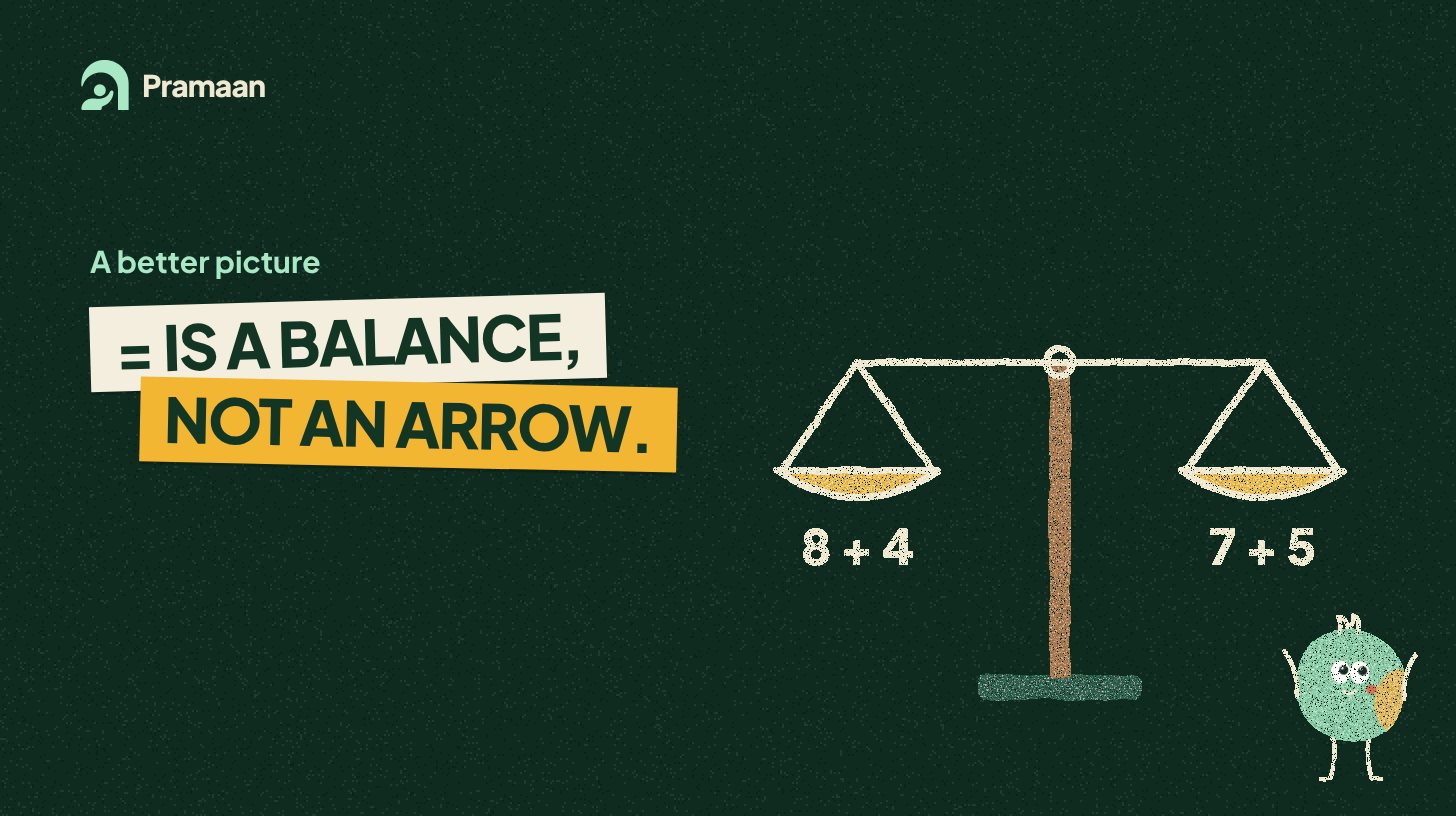
If they write 12, they are in good company. If they write 17, they are too. Both answers come from the same idea, and it is one most of us picked up without noticing: that the equals sign means "now write the answer". The correct answer is 7, because both sides have to come to the same amount.
This looks like a small slip. Researchers who study how children learn maths think it is one of the most important ideas a child carries from arithmetic into algebra.
The study that asked a simple question
In 2006, Eric Knuth and Ana Stephens, mathematics education researchers at the University of Wisconsin-Madison, worked with Nicole McNeil, a developmental psychologist at the University of Notre Dame, and Martha Alibali, a cognitive psychologist at Wisconsin-Madison. They asked 177 students in grades 6, 7 and 8 at one American middle school two things.
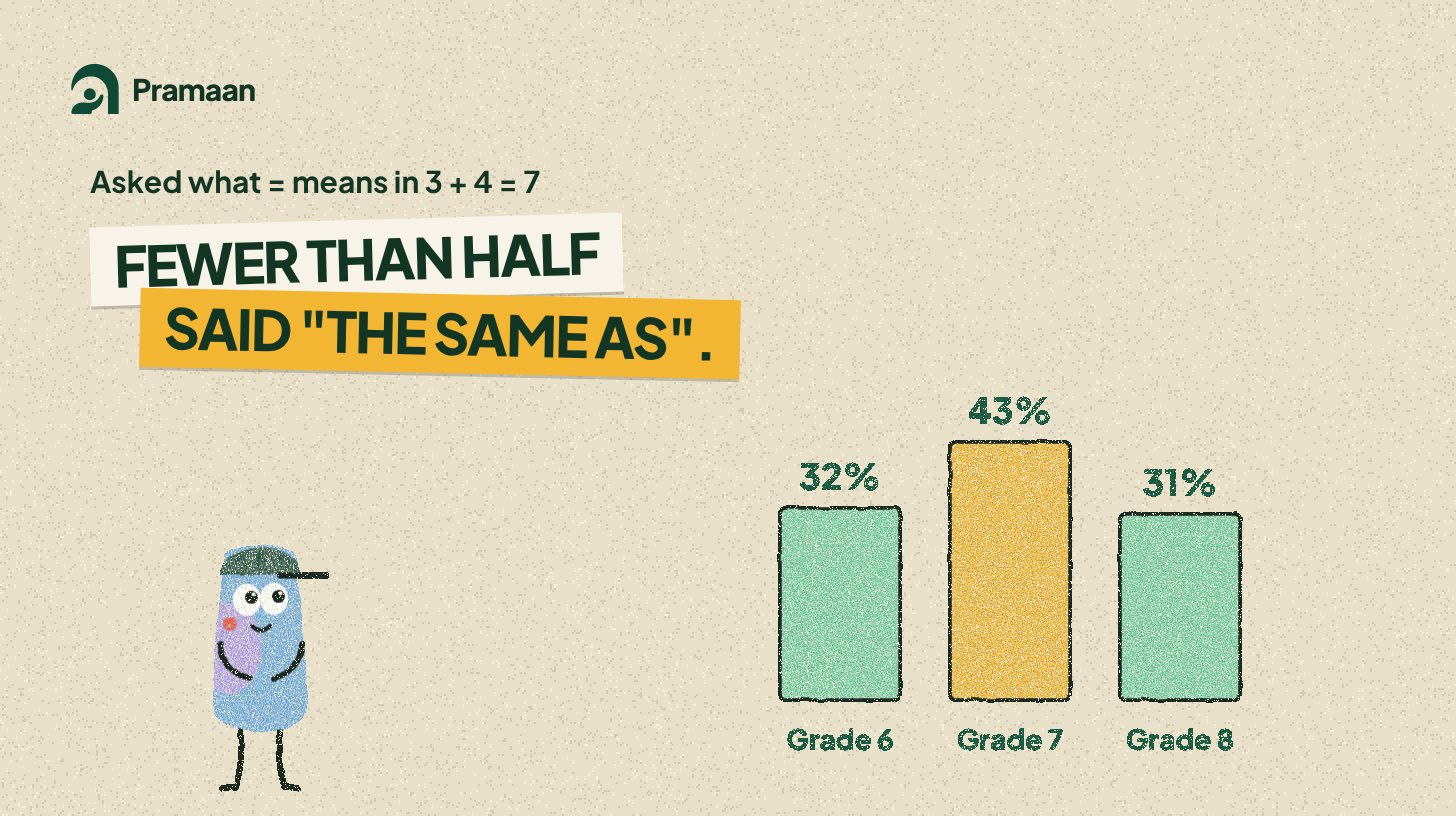
First, a question about the sum 3 + 4 = 7, with an arrow pointing at the equals sign: what is this symbol called, and what does it mean?
Second, a short equation such as 4m + 10 = 70: what value of m makes it true?
The researchers sorted the definitions into two kinds. A relational answer said = means "the same as": the two sides are equal amounts. An operational answer said it means "add the numbers" or "the answer".
What they found
Only about a third of sixth graders (32%) gave a relational definition. In grade 7 it was 43%, and in grade 8 it was 31%. About half of sixth and eighth graders gave the "answer" definition. These were children who had been writing equals signs for six or seven years.
The definition mattered. At every grade, a larger share of students with the relational view solved the equation correctly. The link held even after the researchers took the students' maths test scores into account, so it was not simply that stronger students did better on both questions. In the authors' words, students who understand the equal sign as a relational symbol "are more successful solving algebraic equations than their peers who do not have such an understanding".
It starts early
A second study shows where the habit comes from. McNeil and her colleagues at Notre Dame later followed 112 children from grade 2 into grade 3 and published the results in Child Development in 2019.
In grade 2, the children tried four problems of the same type as the one at the top of this page, such as 1 + 5 = __ + 2. 81 of the 112 children, about 7 in 10, got none of the four right. Only 18% said the equals sign means "the same as", rising to just 22% a year later.
The children who did understand equivalence in grade 2 scored higher on a general maths test in grade 3, even after the researchers allowed for their earlier maths scores, their IQ, gender and family income. The same understanding did not predict their reading, which suggests the link is about maths specifically rather than about being a good student in general.
The researchers' explanation is practice. Children see hundreds of sums written one way, with the operations on the left and the answer on the right. The pattern is so consistent that "= means write the answer" works every time, until the day it doesn't.
What the studies cannot tell us
Both studies are from the United States, and the first comes from a single school. We have not found an Indian study of the same question, so treat these numbers as a strong hint about your child, not a measurement of their class.
Both are also correlational. They show that children who understand the equals sign do better later; they do not prove that teaching it causes the improvement, though McNeil's team checked several obvious alternative explanations.
And the effect in the grade 3 study is real but modest: equivalence explained about 6% of the differences in later maths scores, on top of what earlier maths scores already explained.
What this means at home
The fix is not a new worksheet. It is variety. Children who only ever see "sum = answer" learn that rule. Children who also see 7 = 3 + 4, or 3 + 4 = 4 + 3, or 10 = 10, have to think about what the symbol is saying.
When your child is solving equations in grade 6 or 7 and gets stuck on something like 3x + 5 = 20, it is worth asking: what does the equals sign tell you here? A child who answers "both sides weigh the same" has the tool they need. They can take 5 away from both sides and the balance still holds.
And if your child writes 12 or 17 in the puzzle above, it is not a sign they are bad at maths. It is a sign they have learned the pattern they were shown very well. The next step is to show them a different one.
Sources
- Knuth, Stephens, McNeil and Alibali, University of Wisconsin-Madison and Notre Dame, "Does Understanding the Equal Sign Matter? Evidence from Solving Equations", Journal for Research in Mathematics Education 37(4), 2006 (177 students, grades 6 to 8)
- McNeil, Hornburg, Devlin, Carrazza and McKeever, University of Notre Dame, "Consequences of Individual Differences in Children's Formal Understanding of Mathematical Equivalence", Child Development 90(3), 2019 (112 children, grades 2 to 3)