 Pramaan

Two basic skills that predict whether a child stays in school
A new study followed thousands of adolescents in Bihar and Uttar Pradesh. Those who couldn't read a Class 2 story or do a division were far likelier to leave.
Ask most parents of a 12 year old and they will assume the answer is yes. Can your child read a short Class 2 story aloud without stumbling? Can they divide 744 by 6? Report cards rarely tell you, because by middle school the questions on the paper have moved on, whether or not a child has.
A study published in November 2025 gives those two small skills a second look. It followed thousands of adolescents for three years and found that the ones who could do neither were far more likely to leave school early.
Who did the study
The paper appeared in PLOS ONE, a peer-reviewed journal. Its authors are K. G. Santhya, an independent researcher based in Kollam, Kerala; Nicole Haberland of the Columbia University Mailman School of Public Health in New York; and A. J. Francis Zavier of the Population Research Centre in Gandhigram, Tamil Nadu.
They used data from UDAYA, a large survey of adolescents in Bihar and Uttar Pradesh run by the Population Council, an international research organisation. The same young people were interviewed twice: first in 2015-16, then again in 2018-19.
At the first visit, adolescents aged 10 to 19 were given two short tasks of the kind ASER uses, India's best-known household test of basic learning:
- read a Class 2 level story in Hindi, with no more than three mistakes
- solve a three-digit division sum, usually taught in Class 3 or 4
Each young person was then placed in one of three groups: could do both, could do one, could do neither. The descriptive numbers cover 11,476 adolescents who had ever been to school. The main analysis follows 9,169 who were still in school at the first visit.
What they found
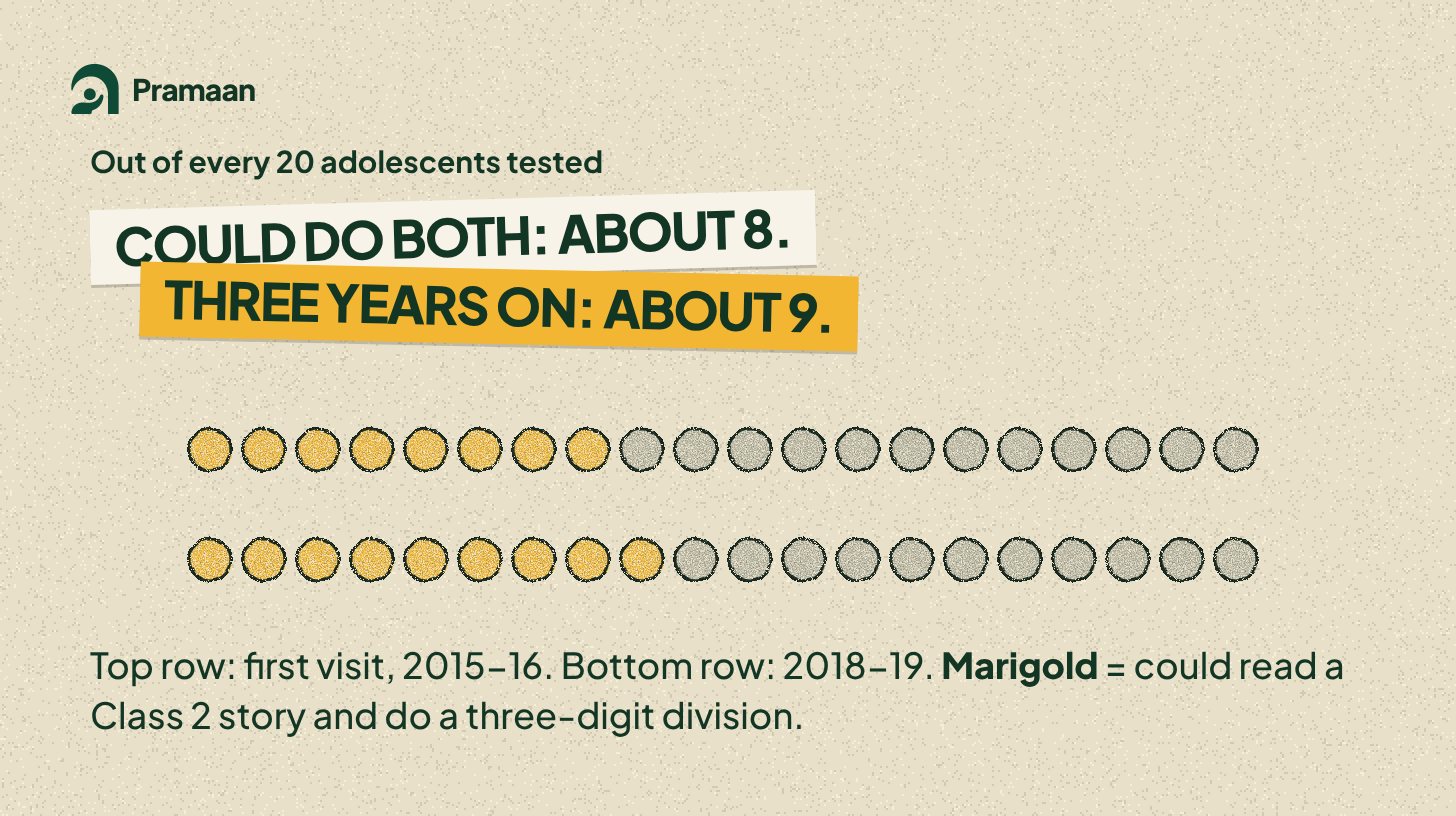
At the first visit, only 41% could do both tasks. A quarter could do neither.
Three years later the picture had improved, but not by much: 47% could do both, which means more than half still had a gap in one skill or both.
Across the sample, the estimated chance of leaving school before finishing Class 12 was 39%. For girls it was 42% and for boys 38%.
Then the finding that matters most. A gap in the basics predicted leaving. Adolescents who could do neither task were far more likely to drop out than those who could do both, even after the researchers accounted for other things that pull children out of school, such as paid work, early marriage and the type of school. A gap in just one of the two skills also raised the risk, by a smaller amount. The pattern held for boys and for girls.
The researchers also ran a stricter test, comparing each adolescent with their own earlier self rather than with other children. In that test only the bigger gap, being unable to do either task, still predicted leaving.
Their conclusion is direct: "Investment in improving foundational skills is paramount for preventing early school leaving for girls and boys." They add that it has to come with other help, from changing beliefs about what girls should do to supporting families.
What the study cannot tell us
A good study is honest about its edges, and this one is.
- It covers two states. A family in Pune or Guwahati lives with a different school system and economy.
- About one in five young people could not be found for the second visit, and the ones who were lost were not a random group. The authors adjusted for this, but it remains a weakness.
- The tests measured only the most basic reading and arithmetic. They say nothing about reasoning, curiosity or how a child feels about school.
- It is observational. It shows a strong link. It cannot show that fixing reading on its own would keep a child in school. The authors suggest that children who succeed may get more encouragement at home and in class, and set bigger goals, but they present this as a possibility they did not test.
Why this matters even if your child is doing fine
Many children whose parents read this blog will pass both tasks easily. The study still carries a lesson for them.
Basic reading and arithmetic are not a primary school topic that ends in Class 5. They are the floor every later subject stands on. A child who reads slowly spends their energy decoding the textbook instead of thinking about it. A child who is unsure of division avoids any problem with a ratio in it. By Class 7 or 8, those small gaps can look like "not a maths person" or "doesn't like reading", when the cause is something much more fixable.
In our labs, children aged 10 to 15 take on real problems that ask them to read a brief, do the sums and argue for an answer. Problems like that are most fun when reading and arithmetic have become easy enough to stop noticing, so a child's attention is free for the interesting part. That floor is worth checking, gently, at home.