 Pramaan

Why 20 Questions is harder for children than it looks
Sixteen objects, four questions. A dinner-table game, the study behind it, and the maths that makes it work.
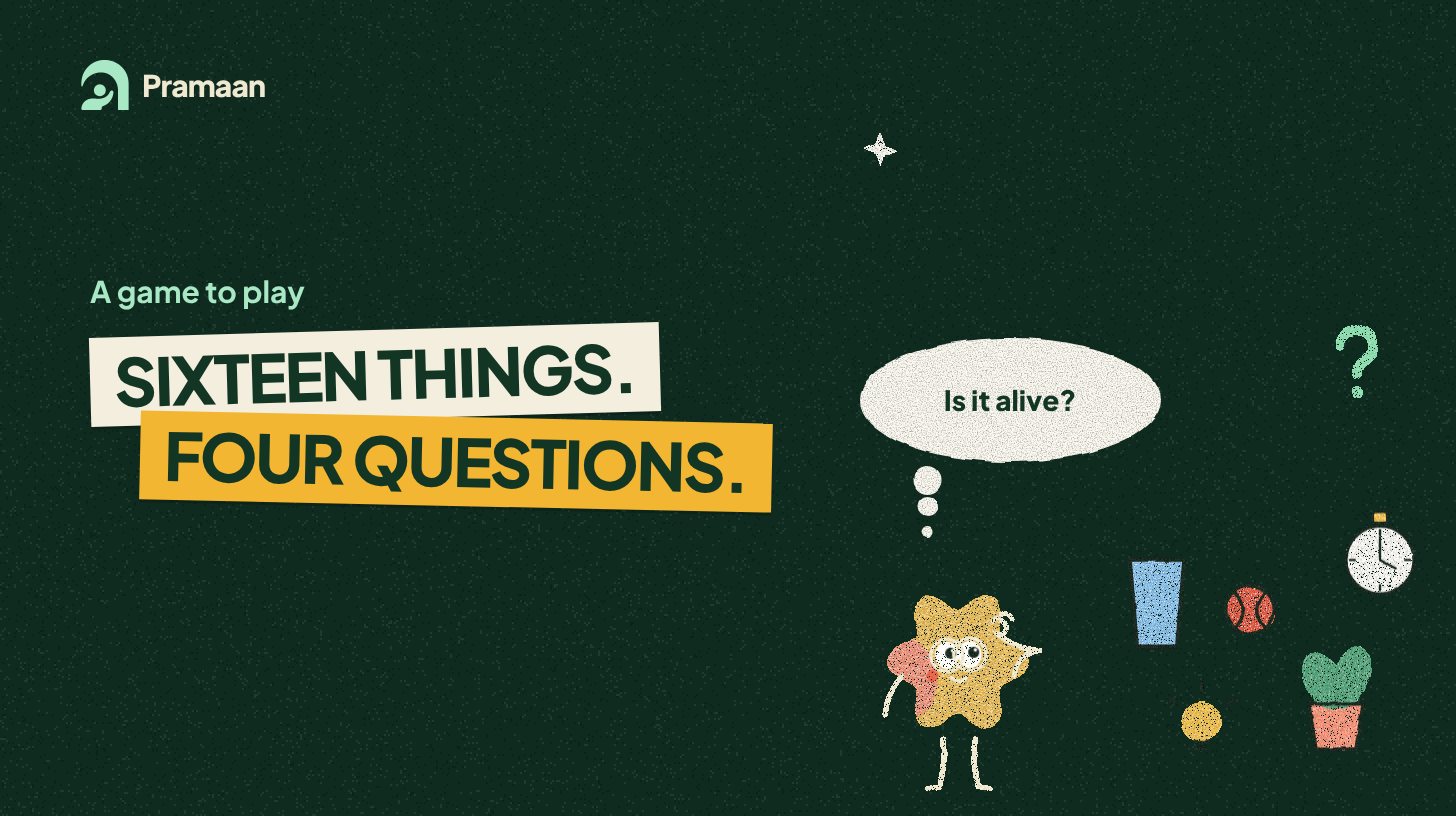
Put sixteen things from around the house on a table: a spoon, a key, a lemon, a toy car. Secretly pick one. Your child has to find it using only questions you can answer with yes or no.
Most children start the same way. "Is it the spoon?" No. "Is it the key?" No. It feels like progress, and it can take fifteen turns. There is a way to do it in four, every single time, and working out why is one of the best bits of thinking a ten-year-old can do at a dining table.
What researchers saw when children played
In 2016, Azzurra Ruggeri, a developmental psychologist then at the University of California, Berkeley and the Max Planck Institute for Human Development in Berlin, published a study with her Berkeley colleagues Tania Lombrozo, Thomas Griffiths and Fei Xu in the journal Developmental Psychology. They gave a version of 20 Questions, with sixteen objects, to 24 seven-year-olds, 23 ten-year-olds and 23 university students.
The adults needed 3.36 questions on average. The ten-year-olds needed 4.38 and the seven-year-olds 4.92. A perfect player, for the puzzles they used, would have needed 2.85.
Two things in the results are worth a parent's attention.
The first is where the adults started. Their opening questions were more often about a big group ("Is it something you eat with?") while children more often opened with a question about one small set of things. A year earlier, in the journal Cognition, Ruggeri and Lombrozo had described the same shift: as children grow, they move from guessing single answers towards questions that rule out many answers at once.
The second finding is the surprising one. Children often kept asking after they already had enough to know the answer. In the study, 83% of the seven-year-olds and 70% of the ten-year-olds asked at least one question when only one possibility was left. So did 52% of the adults. The researchers concluded that a large part of what improves with age is knowing when you can stop.
What the study can't tell us
These were small groups of children in California, playing a game designed in a lab, on one day. The study shows a pattern across ages. It does not show that practising 20 Questions makes a child a better thinker in general, and we won't claim it does. What it gives us is a clear picture of the two habits worth practising: ask about groups first, and notice when you already know.
The maths inside the game
Here is why four questions are enough for sixteen objects.
A question that splits the objects exactly in half is the most useful one you can ask, because whichever answer you get, half the pile disappears. Sixteen becomes eight. Eight becomes four. Four becomes two. Two becomes one.
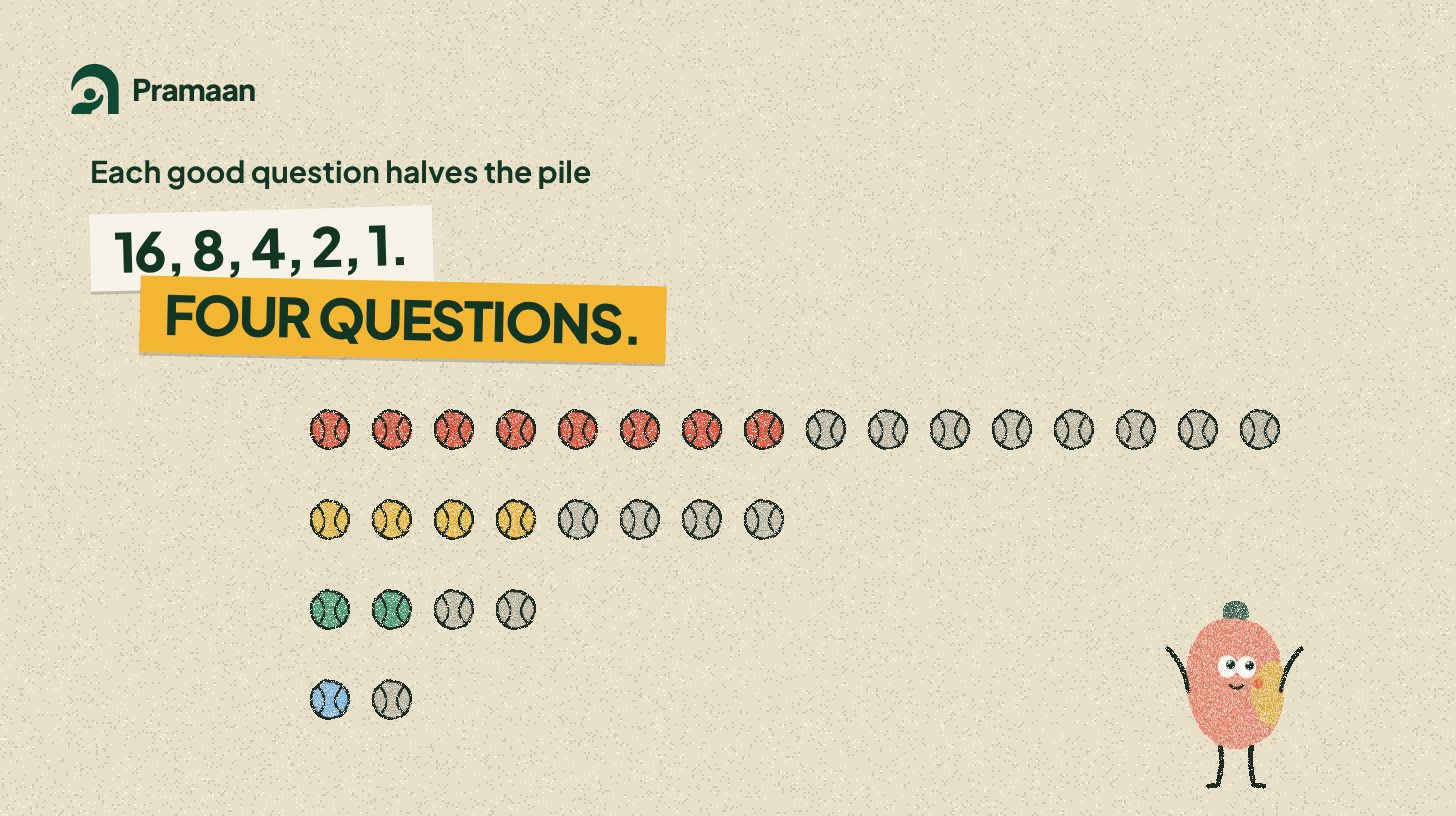
A guess like "Is it the spoon?" splits sixteen into one and fifteen. If you are lucky, you win at once. Usually you are not, and you have removed a single object.
Now run the halving the other way. One question separates 2 things. Two questions separate 4. Three separate 8. Each extra question doubles what you can handle. Keep doubling twenty times and you reach 1,048,576. In principle, twenty perfect questions could pick out one thing from more than ten lakh. That is the idea behind how a computer searches a sorted list, and a child can discover it with a lemon and a toy car.
How to play it at home
You need sixteen small objects and five minutes. Lay them out so everyone can see them all.
Play one round the usual way and count the questions. Don't correct anything. Then ask one thing: "Which of your questions got rid of the most objects?" Let them look at the table and work it out.
Play again. This time, after each answer, your child physically slides away every object that has been ruled out. Watching the pile shrink by half, or by one, teaches more than any explanation from you.
When they can do sixteen in four or five questions, make it harder:
- Add the rule that they must say "I know it" the moment only one object is left, without asking again. That is the stopping skill from the study.
- Swap roles. Answering honestly is harder than it sounds when the question is "Is it made of metal?" and the object is a pencil with a metal band.
- Use 32 objects and ask how many questions it should take now. (Five.)
Why we like this game
It costs nothing, it fits in the time before dinner, and it rewards a child for asking a better question, not for knowing more facts. A child who learns to ask "what would rule out the most?" has a habit that works on a science problem, a missing school bag and a confusing news story alike.
Sources
- Ruggeri, Lombrozo, Griffiths and Xu, UC Berkeley and Max Planck Institute for Human Development, Sources of developmental change in the efficiency of information search, Developmental Psychology, 2016 (24 seven-year-olds, 23 ten-year-olds, 23 adults)
- Ruggeri and Lombrozo, Children adapt their questions to achieve efficient search, Cognition, 2015 (ages 7 to 8, 9 to 11 and 17 to 18)