 Pramaan

The blank-page game: why trying to remember beats rereading
A three-minute family game built on one of the best-tested findings in learning science, and what the research does and doesn't show.
Your child closes the textbook, says "I've read it twice, I know it," and goes off to play. The next morning, in the test, the page in their head is blank.
Rereading feels like learning. The words look familiar, the diagrams make sense, and that smooth feeling is easy to mistake for knowing. Learning scientists have spent decades testing a different habit: closing the book and trying to pull the ideas back out of your own head. They call it retrieval practice, and it is one of the most consistent findings in the study of how people learn.
Below is a three-minute family game built on it, and what the research does and does not tell us.
What happened in an eighth-grade science class
Some of the clearest evidence comes from real classrooms rather than laboratories. Mark McDaniel and Henry Roediger, psychologists at Washington University in St. Louis, worked with Pooja Agarwal and colleagues inside an American middle school. Eighth-grade science students took short quizzes on some of their course material during a unit, while other material was taught but not quizzed. Then everyone sat the teacher's usual unit exam.
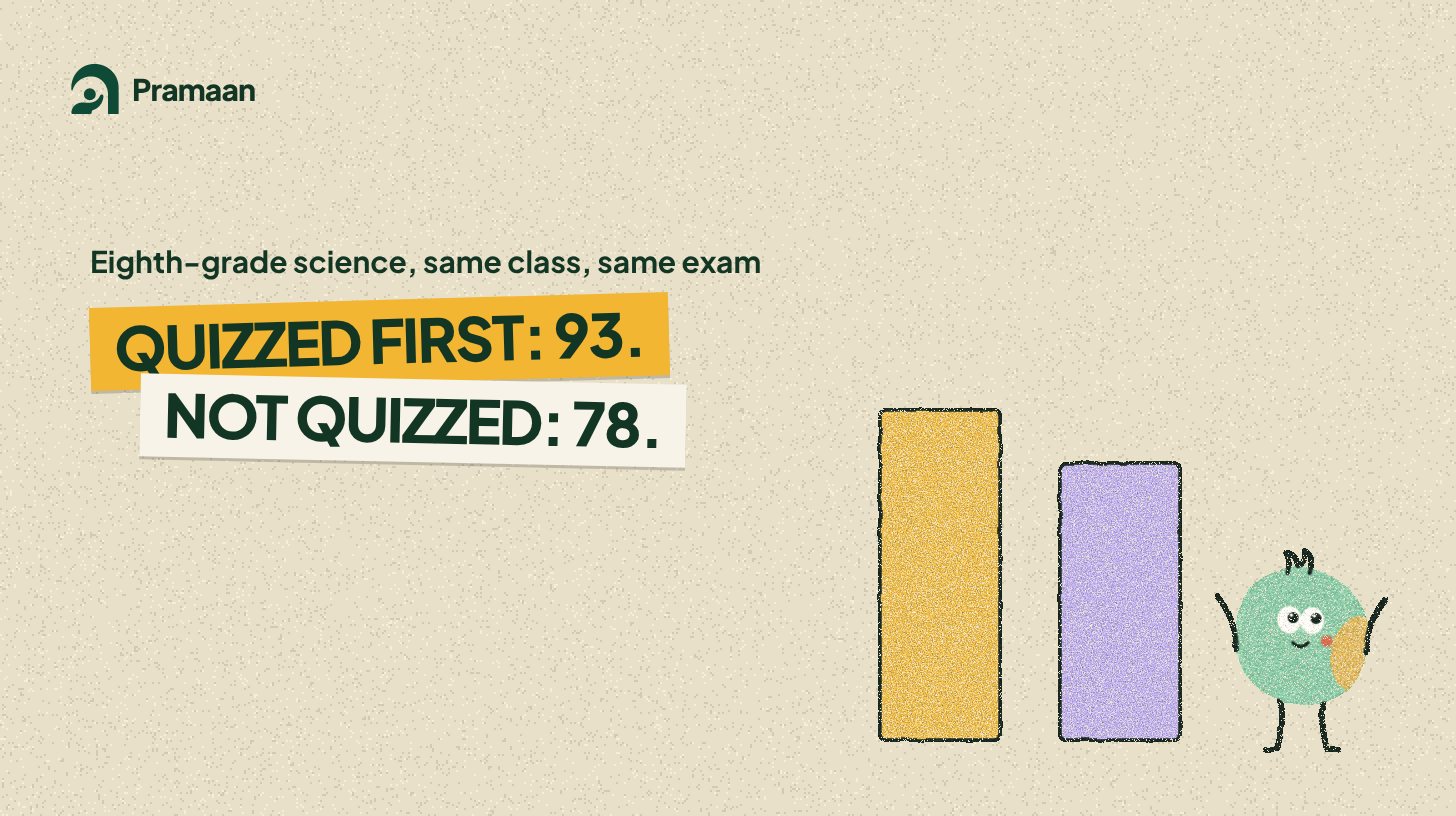
The difference was large. On exam questions about material that had been quizzed, the class averaged 93. On material that had not been quizzed, the average was 78. In letter grades, that is the gap between an A and a C-plus, for the same children, the same teacher and the same exam. The study was published in the Journal of Educational Psychology in 2011.
Two things are worth knowing before you get excited. The quizzes asked about the same facts the exam later tested, so this shows that recalling something makes that thing stick; it says less about whether children get better at science in general. And the quizzes were short. What helped was the act of pulling the answer out, not the pressure of a mark.
Is that one school, or a pattern?
One study can be a fluke. So in 2021, Pooja Agarwal, the cognitive scientist from the St. Louis study, with Ludmila Nunes and Janell Blunt, went looking for every experiment on retrieval practice run in real schools and classrooms. They screened nearly 2,000 abstracts and coded 50 experiments involving more than 5,000 students, from primary school to medical school. Their review appeared in Educational Psychology Review.
The majority of effects, 57%, showed medium or large benefits from retrieval practice. That is a strong record for anything in education, where many popular ideas shrink to nothing when tested in a real classroom.
The limits matter too. About 94% of those experiments were run in the United States and Western Europe. We do not yet have a large body of classroom trials from India. The principle is about how memory works, so we expect it to travel, but we would rather say that plainly than pretend the evidence is local.
Why does trying to remember work?
The short version: memory is not a shelf where facts sit and wait. Every time you successfully pull something back out, you change how easy it will be to find next time. Rereading puts the information in front of you, so your memory never has to do that work. Trying to recall it, even when you struggle and get half of it wrong, makes the path stronger. Checking straight afterwards then fixes the mistakes before they settle in.
This is also why the struggle matters. A child who writes three things on a blank page and then discovers the five they forgot has learned more than a child who reread the page and felt good about it. The first child feels worse in the moment. The research says they are better off.
The blank-page game
This is a game, not homework. It works best when parents play too, on something they read or watched that day.
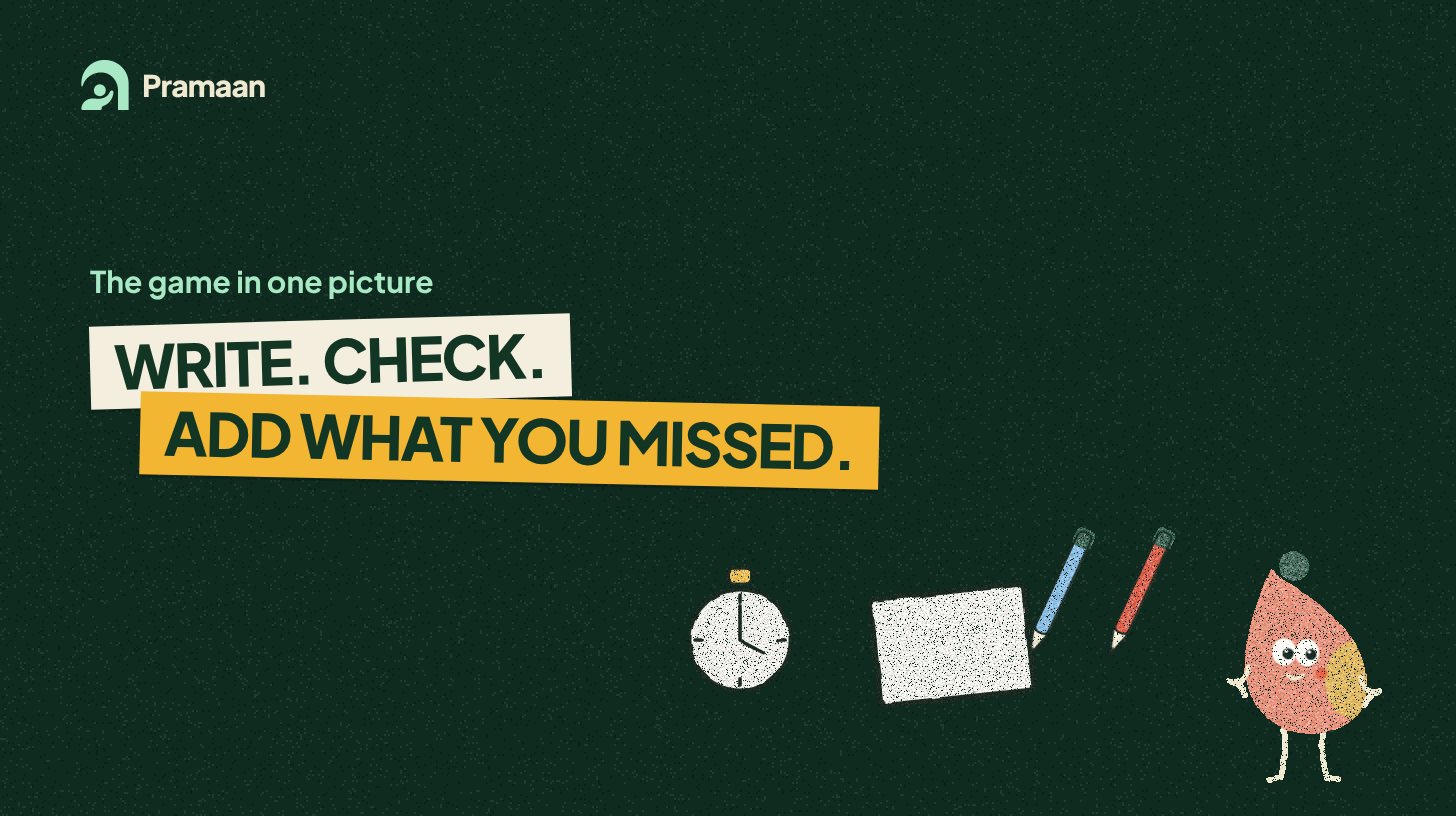
What you need: one blank sheet and two pens of different colours for each player, and a timer.
The rules:
- Each player picks one thing they learned or read today: a chapter from school, a news story, a cricket match, a recipe, a documentary.
- Set the timer for three minutes. Everyone writes down everything they can remember about their topic. Lists, words, little drawings, numbers. No looking.
- When the timer rings, each player opens their book, article or notes for one minute and checks.
- Score one point for each correct thing you wrote from memory.
- Now, in the second colour, add the important things you missed.
- Two or three days later, play again on the same topics with a fresh page. Score one point for each correct item, and two points for anything that was in the second colour last time and is now in your first colour. That bonus rewards exactly what the research cares about: something you had lost and won back.
A few tips. Keep it light: no prizes for the top score, no comparing a child's page with a sibling's. Let wrong answers be funny rather than embarrassing. And keep it short. Three minutes is enough to make memory do its work without turning dinner into an exam.
What to expect
Expect the first round to be humbling, for adults especially. Most of us remember far less of a newspaper article than we would guess. That surprise is useful: it is the same gap between "it looks familiar" and "I can actually say it" that your child faces every exam season.
What you are building, more than marks, is a habit your child can use alone: close the book, write what you know, check, fix. A child who owns that habit does not need anyone to quiz them. At Pramaan, our teams of children aged 10 to 15 spend their time on real problems rather than flashcards, but the same idea runs underneath: what you can explain without the book is what you actually know.
Sources
- Washington University in St. Louis news, Quizzes key to learning for middle school students, 7 Mar 2011 (eighth-grade science; quizzed items averaged 93, non-quizzed 78), reporting McDaniel, Agarwal, Huelser, McDermott and Roediger, Journal of Educational Psychology, 2011
- McDaniel, Agarwal, Huelser, McDermott and Roediger, Test-enhanced learning in a middle school science classroom, Journal of Educational Psychology, 2011 (ERIC record)
- Agarwal, Nunes and Blunt, Retrieval practice consistently benefits student learning: a systematic review of applied research in schools and classrooms, Educational Psychology Review, 2021 (50 experiments, more than 5,000 students, 57% medium or large effects, 94% US and Western Europe)