 Pramaan

Same nine votes, three different winners. How?
A problem from our labs about running for office, the maths of counting votes hiding inside it, and a family election you can hold tonight.

In 2004, A. R. Krishnamurthy, a politician from Karnataka, stood for the Santhemarahalli Assembly seat and received 40,751 votes. His rival, R. Dhruvanarayana, received 40,752. A recount changed nothing. Twenty years later, in the 2024 Lok Sabha election, Ravindra Waikar won Mumbai North West by 48 votes, the smallest margin in the country that year.
Most of us read stories like these as stories about turnout: every vote counts, so go and vote. They are. But they also hide a stranger question, one that children find far more interesting once they see it. Who wins depends on how many people vote. Who wins can also depend on how the votes are counted.
The problem we posed
In one of our recent labs, teams were asked to run for office. Each team had to choose a cause, make promises, and win a room of voters. Somewhere along the way the question always surfaces: what counts as winning?
We don't hand over the answer. We give teams a small pile of ballots and let them count. Here is a version of that pile.
Nine ballots, three plants
Nine children are choosing one plant for a school garden: tomato, chilli or marigold. Each child ranks all three, first to last.
- 4 children rank: Tomato, then Marigold, then Chilli
- 3 children rank: Chilli, then Marigold, then Tomato
- 2 children rank: Marigold, then Chilli, then Tomato
Before reading on, decide who should win. Then try three ways of counting.
Count only first choices. Tomato has 4, Chilli 3, Marigold 2. Tomato wins. This is how Indian elections work: the candidate with the most votes takes the seat, even without a majority.
Run off the top two. No plant has more than half, so drop the last one, Marigold. Its 2 voters preferred Chilli over Tomato, so Chilli now has 5 and Tomato 4. Chilli wins. Several countries elect presidents roughly this way.
Give points. A first choice earns 2 points, a second 1, a last 0. Tomato gets 8. Chilli gets 8. Marigold, which almost nobody put first but almost everybody put second, gets 11. Marigold wins.
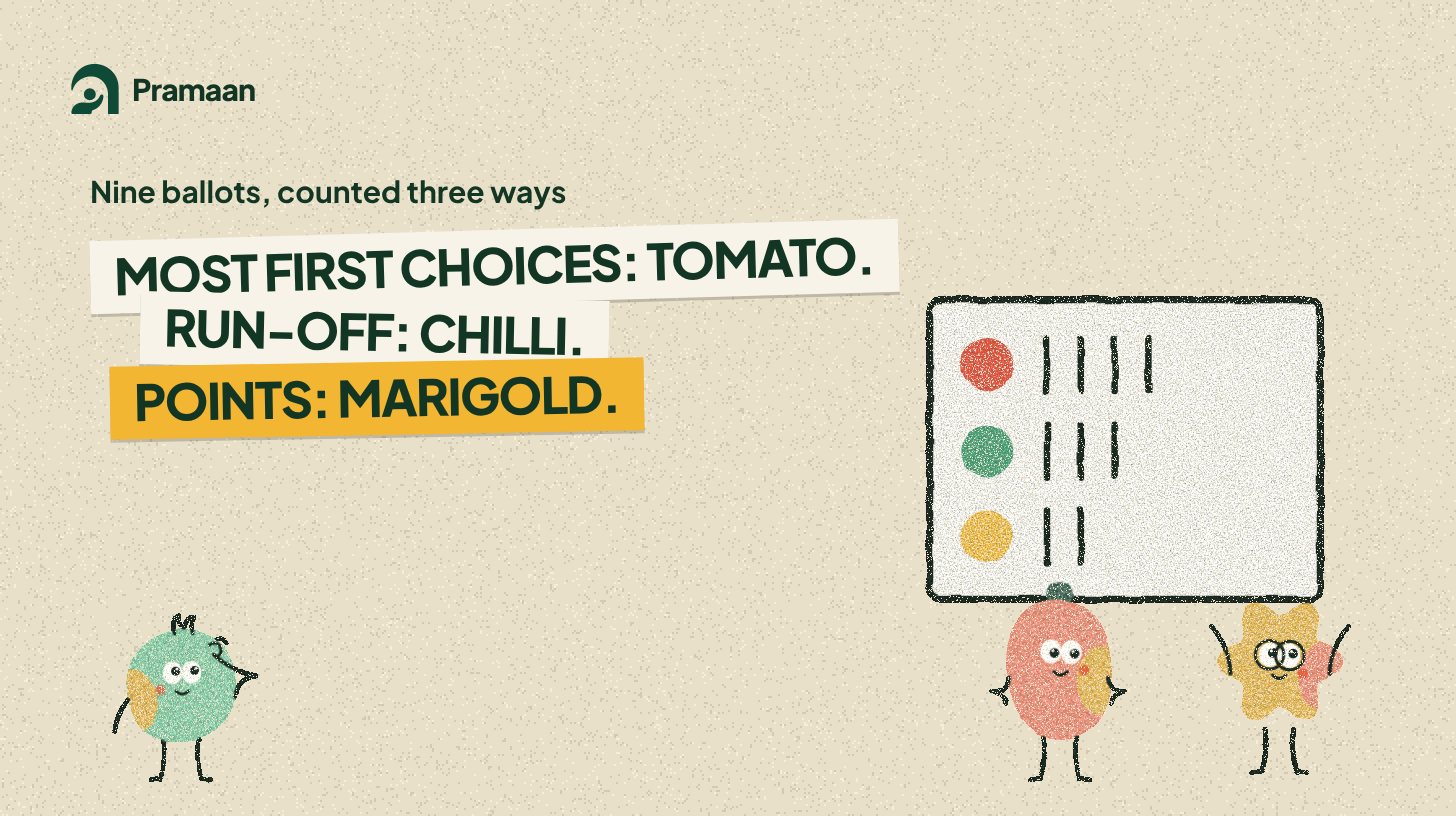
Same nine ballots, three different winners. Nobody cheated and nobody miscounted. The rule did the choosing.
Which winner is right?
Here is a fourth test that teams usually invent on their own: put each pair of plants head to head. Marigold against Tomato: 5 children prefer Marigold, 4 prefer Tomato. Marigold against Chilli: 6 to 3. Marigold beats each rival one on one, yet it came last under the rule most of us use.
This is not a trick of our numbers. The French mathematician the Marquis de Condorcet worked through problems like this in 1785. He also found something worse: sometimes there is no candidate who beats every other one. A group can prefer A to B, B to C and C to A, like a game of rock, paper, scissors. In 1951 the economist Kenneth Arrow, who later shared a Nobel prize, proved that no ranked voting rule can satisfy a short list of reasonable fairness conditions all at once. Eric Pacuit, a philosopher at the University of Maryland who studies voting, lays out the trade-offs clearly in the Stanford Encyclopedia of Philosophy: every method gives up something.
That sounds gloomy. For a 12 year old, it is the opposite. It means the question "what is fair?" has no answer in the back of the book, and their argument counts.
Why this matters for children
The maths here is fractions, totals and comparisons, well within reach of a child aged 10 to 15. What makes it hard is that it asks them to hold two ideas at once: the arithmetic is correct, and the result is still open to argument. Children who can sit with that are better prepared for most decisions they will face in a class, a team or a family.
There is also a lesson about promises. A candidate who knows the counting rule campaigns differently. Under first choices, you chase your loyal voters. Under points, you try to be everyone's comfortable second choice. Teams notice this fast, and it changes the speeches they write.
A few honest limits. Our nine ballots were built to split three ways; most real elections are not this neat, and the different rules often agree. Close margins like Santhemarahalli's or Mumbai North West's are about turnout and counting care, not about the counting rule. And none of this says one system is best. That is a question for your dinner table.
Sources
- Deccan Herald on A. R. Krishnamurthy, Santhemarahalli Assembly election, 2004 (40,751 votes to 40,752)
- ThePrint, 5 June 2024: Ravindra Waikar wins Mumbai North West by 48 votes, lowest margin of the 2024 Lok Sabha polls
- Pacuit, University of Maryland, Voting Methods, Stanford Encyclopedia of Philosophy (Condorcet 1785, Borda count, run-offs, Arrow 1951)