 Pramaan

Real or made up? A dinner game that trains a fake-news radar
A trial with 13,500 teenagers in Bihar found that a few classes made them better at telling true stories from false ones. Here is a family game built on it.
Your child forwards you a video in the family group. A famous scientist has supposedly said the monsoon will skip a state this year. It looks official. It has a logo. Do they believe it?
The honest answer for most of us, adults included, is "sometimes". The good news from a large new study in India is that telling true from false is a skill, children can get measurably better at it in a handful of classes, and the gain does not vanish once the classes end. Below is what the researchers found, and a dinner-table game you can play tonight that uses the same moves.
The trial in Bihar
Between November 2023 and March 2024, a team of political scientists ran a large trial with teenagers in Bihar. Priyadarshi Amar and Simon Chauchard of Carlos III University of Madrid, Sumitra Badrinathan of American University in Washington DC, and Florian Sichart of Princeton University worked in 583 villages across 32 districts of Bihar. Classes were held in 100 community libraries, offline, for more than 13,500 adolescents aged 13 to 18.
Villages were assigned by lottery. In half, teenagers took four classes spread over about 14 weeks, with homework, on how false stories spread and how to check them. In the other half, teenagers got the same number of classes in conversational English. That second group matters: it means any difference is about the content, not about simply having an interesting class to attend.
The results were published in the American Political Science Review, a leading political science journal, in 2026.
What changed, and what didn't
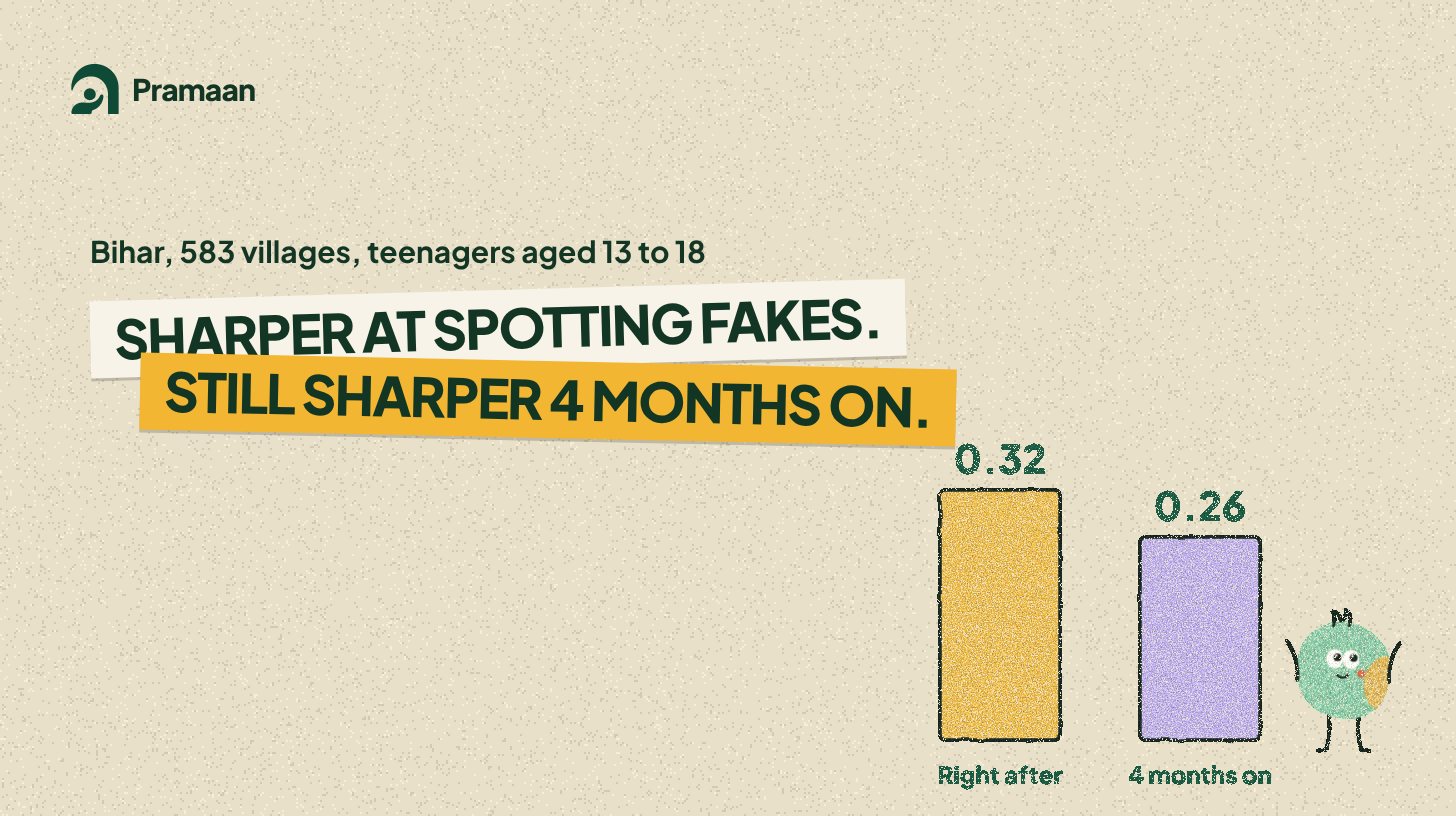
Teenagers who took the classes were better at sorting true stories from false ones. The researchers measured the improvement as 0.32 of a standard deviation compared with the English-class group. On paper that is a modest shift. For four classes, delivered in village libraries to thousands of teenagers, it is a real one.
Three details made us pay attention.
- It lasted. About four months later the team went back to 2,059 of the students. The gain was still there, at 0.26 of a standard deviation.
- It travelled. On new political stories that were never covered in class, students still did better. They had learned a habit, not a list of fakes.
- It reached home. Parents of the students who took the classes were also better at telling true from false. Nobody taught the parents. The children did.
The study is honest about its limits. The classes were a bundle, so we cannot say which part did the work. The teenagers did not become more likely to act, for example by correcting a false post, except among boys. And everything was measured by survey, not by watching what students actually shared.
Why tips alone are not enough
An earlier study shows why practice matters more than advice. In 2020 Andrew Guess, a political scientist at Princeton University, led a team that included Neelanjan Sircar of Ashoka University in testing Facebook's short "Tips to Spot False News" on nearly 12,000 people in the United States and India. In the online samples, simply reading the tips improved people's ability to tell mainstream from false headlines by 26.5% in the United States and 17.5% in India. In a face-to-face sample in rural India, where people had far less experience judging online headlines, the tips made no measurable difference. In the US the effect also faded over the following weeks.
Our reading of the two studies together: a list of tips helps people who already practise judging news. For everyone else, the practice has to come first. That is what a game gives you.
The game: Two true, one made up
You need three small slips of paper per round, a pen and, for the checking part only, one phone.
The Editor. One player is the Editor for the round. Before dinner, they write three short claims, each one sentence. Two are true and come from a newspaper or a reliable website. One is made up. The made-up claim should sound plausible and be harmless: nothing about a real person's private life, health, religion or caste.
Vote first. The Editor reads all three. Everyone else gets three questions in total to ask the Editor, such as "Who said it?" or "Where was it first reported?" Then each player privately marks one slip as the fake.
Then check. Now, and only now, the phone comes out. Players get three minutes to check the claims the way fact-checkers do: leave the page the claim is on, search for the claim itself, and look for two places that report it independently.
Score the clue as well as the answer. One point for spotting the fake. One more point for naming the clue that gave it away: no date, no named source, a number that seemed too neat, a headline that wanted you to feel angry. The Editor scores a point for every player they fooled, and then has to explain what made the fake convincing.
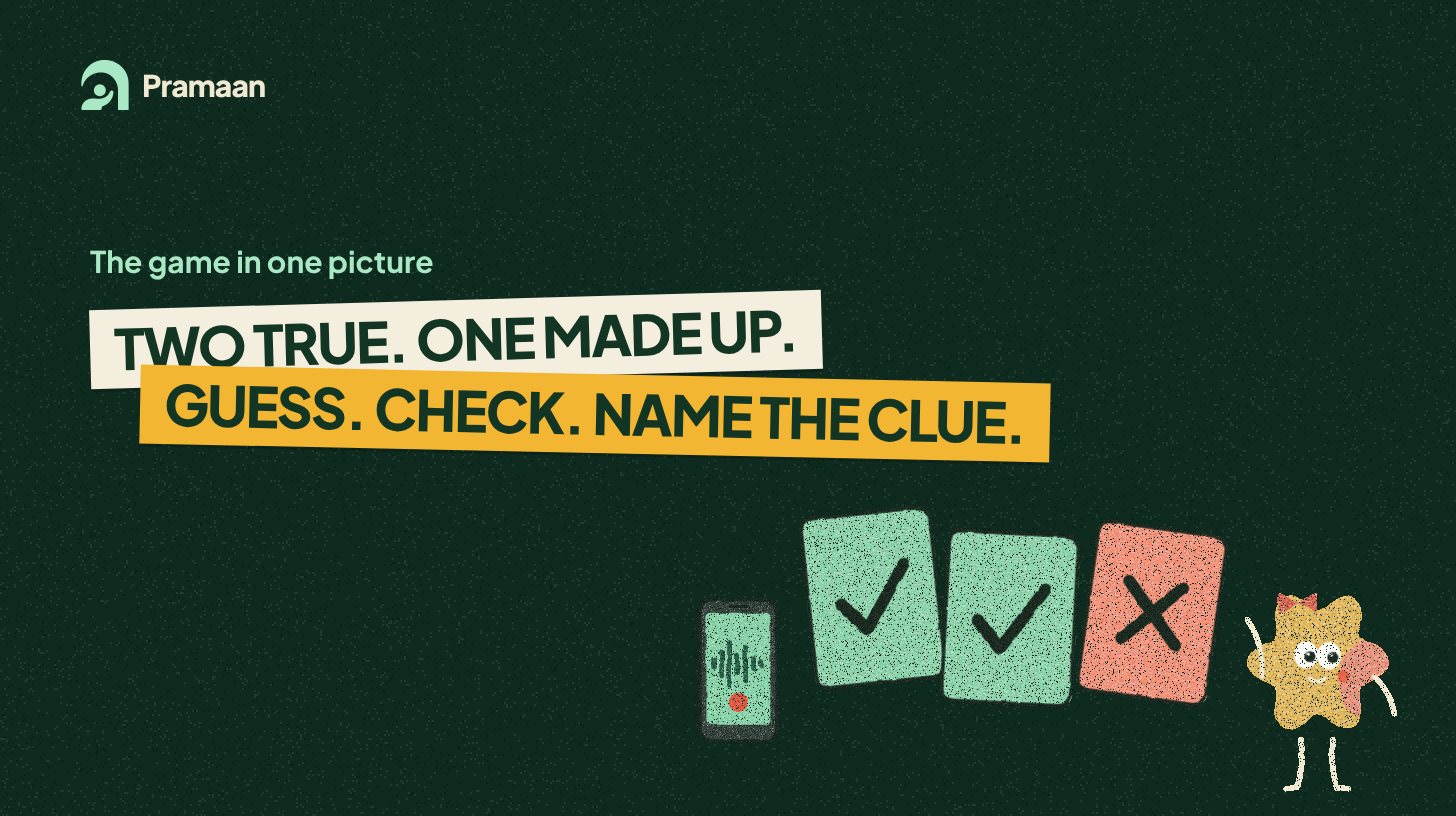
Rotate the Editor each round, and give your child the role often. Writing a convincing fake forces them to think about what makes a claim feel true, and that is the same knowledge they need to see through one.
What to listen for
The interesting moment is not the vote. It is the argument after it. When your child says "I knew it was fake because the number was too round" or "there was no name", they are describing a test they can reuse. When they are wrong, ask what would have changed their mind. You are not trying to make them suspicious of everything. You are trying to make them ask "How would I know?" before they forward.
At Pramaan, our teams work with real data on real problems, and checking where a number came from is part of every one. This game is the home version of that habit.
Sources
- Amar, Badrinathan, Chauchard and Sichart, Carlos III University of Madrid, American University and Princeton University, Countering misinformation: early evidence from a classroom-based field experiment in India, American Political Science Review, 2026 (583 villages, 32 districts of Bihar, over 13,500 adolescents aged 13 to 18; discernment +0.32 SD, +0.26 SD after about four months for 2,059 resurveyed)
- Schoenberger, Fighting Misinformation Works, Stanford Social Innovation Review, Spring 2026 (summary of the Bihar trial)
- Guess, Lerner, Lyons, Montgomery, Nyhan, Reifler and Sircar, A digital media literacy intervention increases discernment between mainstream and false news in the United States and India, PNAS, 2020 (11,924 people; discernment +26.5% US, +17.5% India online; no measurable effect in a face-to-face rural India sample), via Princeton SPIA