 Pramaan

"You're so smart!" What the praise research really found
A famous 1990s experiment, a 12,000-student trial and two big reviews: what they say about how to praise your child, and what they don't.
Your child brings home a maths test with 19 out of 20. Before you have finished reading it, the words are out: "You're so smart!" It feels like the kindest thing a parent can say. A small set of experiments from the late 1990s suggested it might be one of the least helpful, and the research that followed has made the story more interesting than the posters on staffroom walls let on.
The experiment that started it
Carol Dweck, a psychologist now at Stanford University, and her student Claudia Mueller ran a series of experiments with fifth graders, children of about 10 and 11. Every child solved a set of puzzles and got the same score. Then one group heard, "You must be smart at these problems." Another heard, "You must have worked hard at these problems."
The next choice was revealing. Most children praised for being smart picked an easy set of puzzles next, the kind that would keep them looking smart. Most children praised for effort picked a harder set they could learn from.
Then every child got a set of puzzles that was too hard for them. Afterwards, when the problems were easy again, the children praised for intelligence did worse than they had at the start. The effort group did well and kept improving.
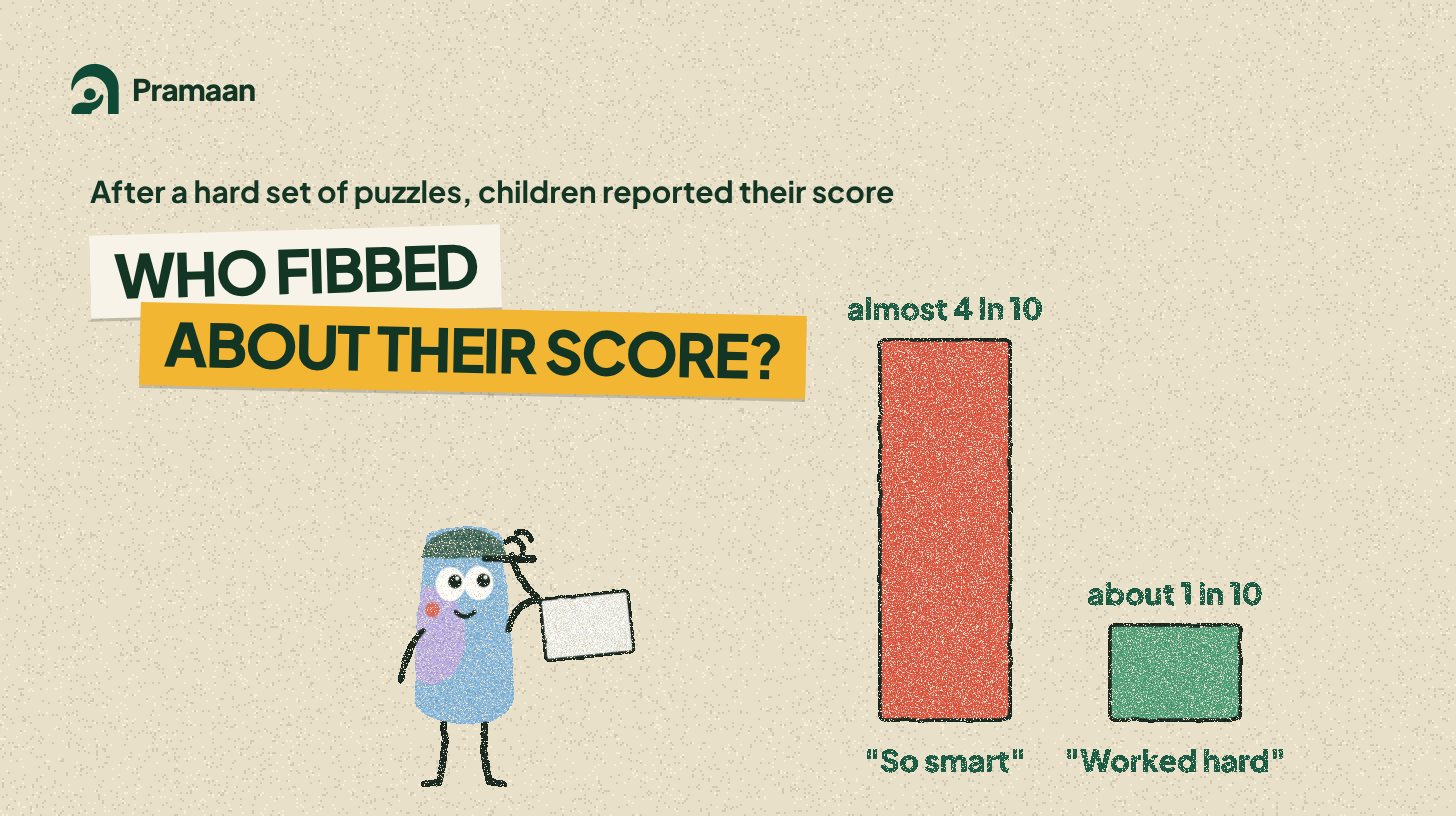
The detail that gets quoted most came at the end. Children were asked to write to a child at another school about the task, with a space to report their score. In Dweck's account, almost 4 in 10 of the children praised for intelligence lied about their score. Among the effort group it was about 1 in 10.
Dweck's explanation became the idea of a "growth mindset": children who believe ability can grow treat a hard problem as a chance to learn, while children who believe ability is fixed treat it as a test they might fail. Praise for being clever, Dweck argued, nudges children towards the second view.
The big test, twenty years later
A lab result with one classroom of puzzles is one thing. Whether a short lesson about the brain can change real school grades is another. In 2019, David Yeager, a psychologist at the University of Texas at Austin, led a national experiment published in Nature to find out.
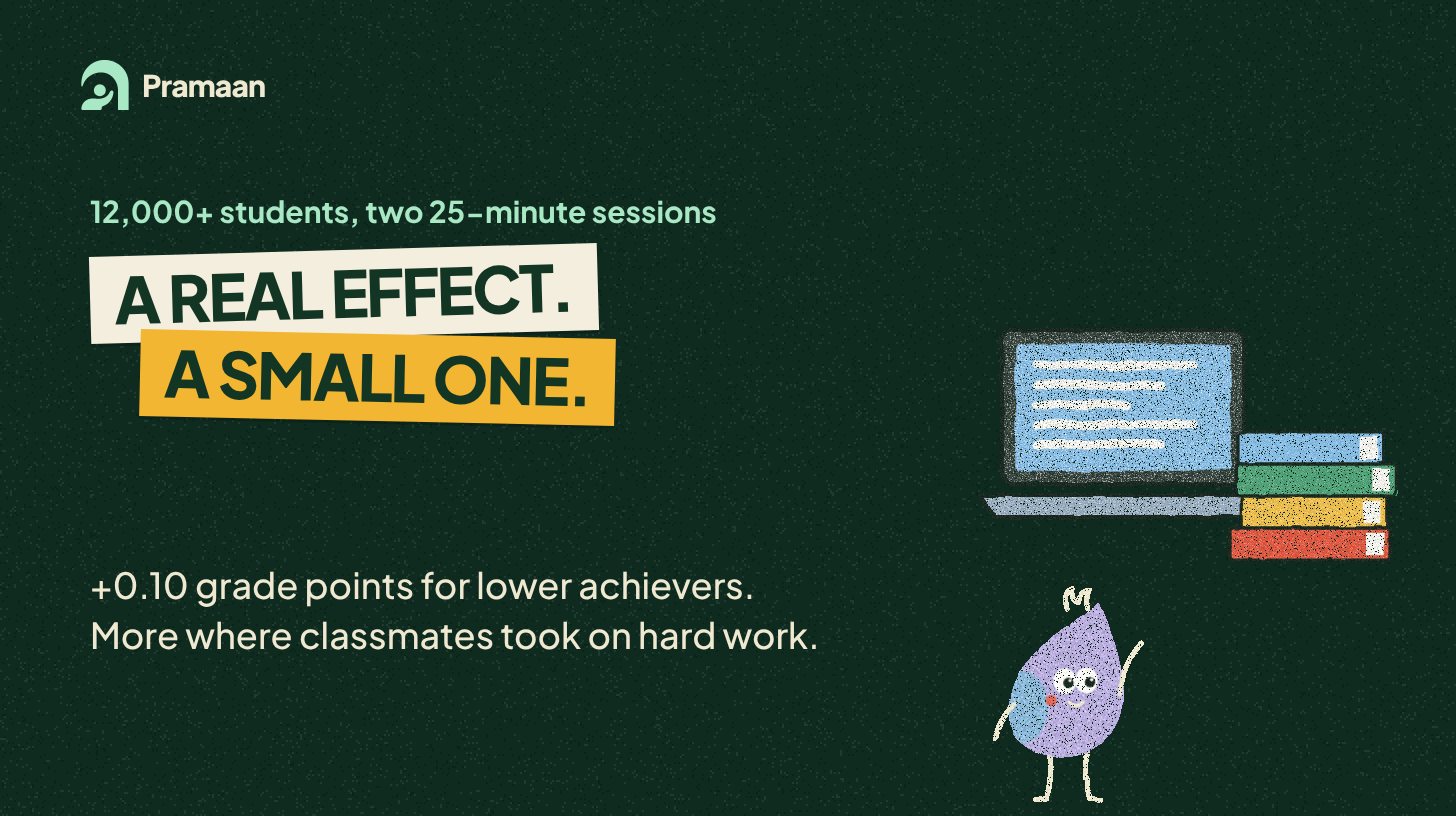
More than 12,000 ninth graders in 65 state schools across the United States took part. Half did two online sessions of about 25 minutes each, learning that the brain gets stronger when it works on hard problems. The rest did a similar-looking lesson about the brain with no mindset message.
The result was real and small. Among lower-achieving students, grades in core subjects rose by 0.10 grade points on a four-point scale, and the share with a failing D or F average fell by more than 5 percentage points. In schools where classmates were already willing to take on harder courses, the gains were larger, around 0.15 grade points. Where the peer culture pushed the other way, the lesson did much less.
That second finding matters as much as the first. A message about effort works better in a room where effort is normal.
Then the sceptics weighed in
In 2023 the journal Psychological Bulletin published two large reviews of mindset programmes in the same issue, and they read the evidence differently.
Brooke Macnamara, a psychologist at Case Western Reserve University, and Alexander Burgoyne, of the Georgia Institute of Technology, pooled 63 studies of academic achievement. The average effect was close to zero (d = 0.05). When they kept only the studies with the strongest designs, the effect was smaller still and no longer distinguishable from zero. They also reported that most studies could not separate the mindset message from everything else in the lesson.
A team led by Jeni Burnette, a psychologist at North Carolina State University, looked at 53 programmes and asked a different question: for whom do they work? Their answer was that effects on grades were modest overall but clearer for students expected to benefit most, such as those already struggling, and when the programme was delivered as designed (d = 0.14 in those groups).
Both reviews agree on more than the headlines suggest. A short mindset lesson is not a cure for low marks. For some children, in some settings, it helps a little.
What this means at your dinner table
Most of this evidence comes from the United States and Europe, and none of it tested what Indian parents say to their children at home. With that limit in mind, three things hold up.
Praise what your child did, not what they are. "You tried a different method when the first one didn't work" tells a child what to do next time. "You're a genius" tells them what they have to protect.
Skip the empty version. "Good effort!" said after a child has been stuck on the same wrong method for an hour is not growth mindset. Dweck herself has warned against praising effort that isn't leading anywhere. Praise the switch in strategy, the question they asked, the second attempt.
Look at the room, not only the words. Yeager's study found the message worked best where classmates also took on hard things. At home, that room is you. A parent who says "I don't know, let's work it out" when the electricity bill doesn't add up is making the same point without a lecture.
We care about this because the children in our labs spend most of their time on problems none of them can solve on the first try. What we say when the first model collapses shapes whether they try a second one.
Sources
- Dweck, Stanford University, 'The Perils and Promises of Praise', Educational Leadership, 2007 (summary of Mueller and Dweck, Journal of Personality and Social Psychology, 1998; fifth graders)
- Yeager et al., University of Texas at Austin, 'A national experiment reveals where a growth mindset improves achievement', Nature, 2019 (12,000+ ninth graders, 65 US schools)
- Macnamara (Case Western Reserve) and Burgoyne (Georgia Tech), Psychological Bulletin, 2023 (63 studies; d = 0.05 overall), with their reply to commentaries
- Burnette et al., North Carolina State University, Psychological Bulletin, 2023 (53 samples; d = 0.14 for targeted, high-fidelity groups)