 Pramaan

A phone at 12: what a study of 10,000 children found
A large new study links owning a smartphone at 12 with poorer sleep, more weight gain and more low mood. Here is what it can and can't tell you.
Somewhere between Class 5 and Class 7, the question arrives in most homes. Everyone in the class seems to have one. The school group is on WhatsApp. Tuition timings come by message. So: does your child get a phone now, or next year, or later?
A large study published in December 2025 does not settle that question, but it gives parents better information than most of what gets forwarded in family groups. Here is what it found, and what it can't tell us.
Who did the study
The paper was led by Ran Barzilay, a child psychiatrist at the Children's Hospital of Philadelphia and an assistant professor at the University of Pennsylvania's Perelman School of Medicine, with colleagues from UC Berkeley and Columbia University. It appeared in Pediatrics, the journal of the American Academy of Pediatrics.
The team used the Adolescent Brain Cognitive Development (ABCD) study, the largest long-term study of brain development and child health in the United States, which has followed children at 21 sites since they were 9 or 10. Every year the children say whether they own a smartphone, so the researchers could work out roughly when each child got one. They looked at 10,588 children. The median age for a first phone was 11.
At 12, they checked three things: a depression screen, body mass index (for obesity) and sleep, counted as insufficient if a child slept less than nine hours a night.
What they found
Compared with 12-year-olds who did not own a smartphone, those who did had:
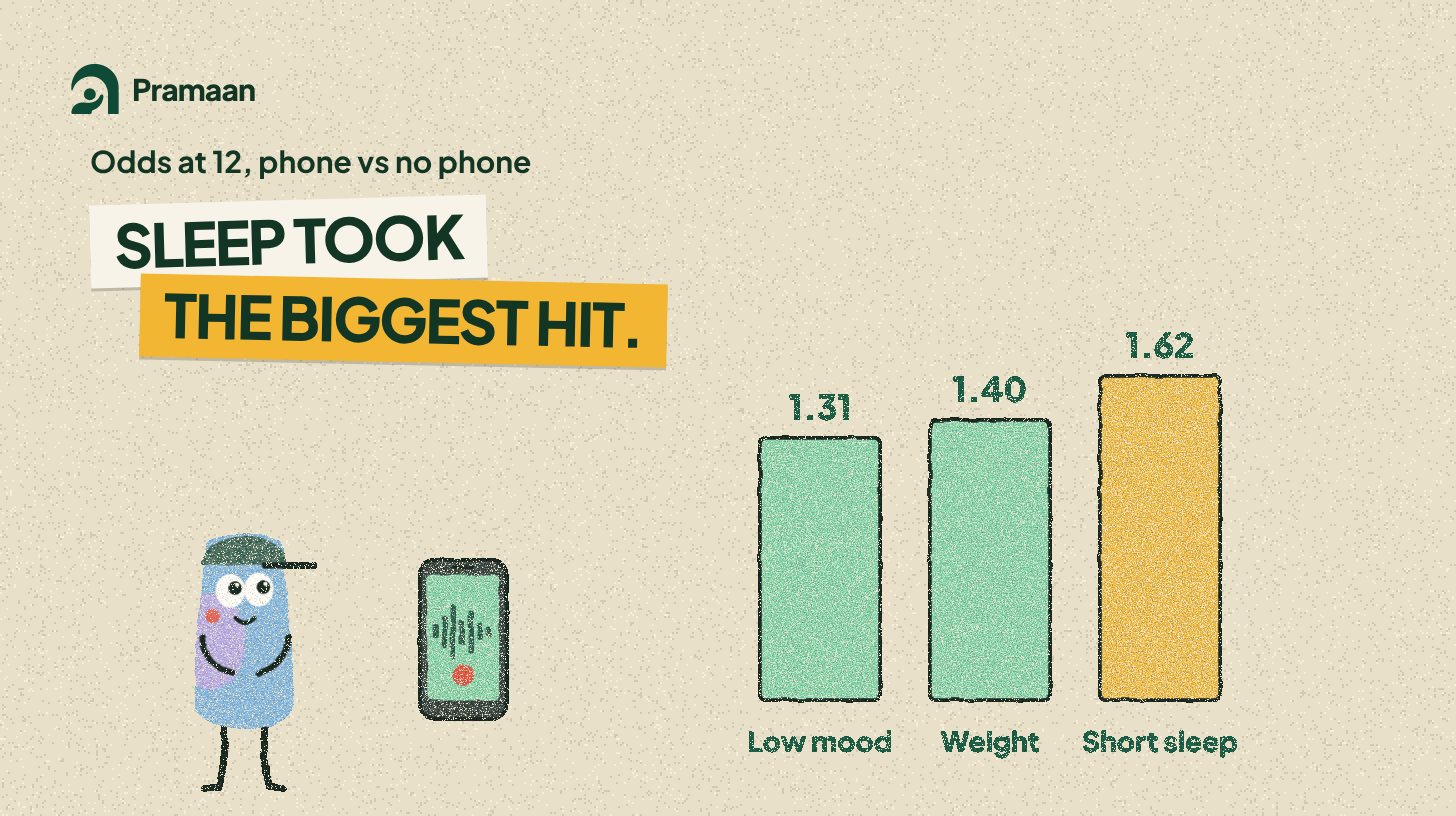
- odds of depression about a third higher (an odds ratio of 1.31)
- odds of obesity about 40% higher (1.40)
- odds of insufficient sleep about 60% higher (1.62)
The younger a child was when the phone arrived, the higher the odds of obesity and short sleep at 12. That pattern did not hold for depression.
The team then looked at children who had no phone at 12 and got one in the following year. Compared with children who still had no phone at 13, they had higher odds of mental health problems at a clinical level (1.57) and of insufficient sleep (1.50). In other words, the change showed up within a year of the phone arriving, not only after years of use.
These links held after the researchers adjusted for family income, parents' education, puberty, how closely parents monitored their children, and whether the child had other devices such as a tablet or laptop.
What it can't tell us
This is the part that usually gets lost in the headlines, so it is worth being plain about it.
- It shows a link, not a cause. Families who give a phone at 10 may differ from families who wait, in ways no survey captures. A child who is already sleeping badly or feeling low may also be more likely to be handed a phone.
- It doesn't know what the phone was used for. Video calls with grandparents and three hours of short videos after midnight count the same here. The researchers say they did not study which features of phone use matter.
- Odds are not certainties. A 60% rise in the odds of short sleep does not mean most children with phones sleep badly. It means the group, on average, did worse.
- The children are American. Indian homes differ in shared rooms, school timings, tuition schedules and who else uses the phone. The direction of the findings is plausible here; the exact numbers may not travel.
Barzilay told The Philadelphia Inquirer that the team is not saying smartphones are bad, and not saying they are good either.
What this means at home
Of the three findings, sleep is the one parents can act on most directly. It had the largest link, it showed up both at 12 and in the year after a phone arrived, and it has an obvious mechanism: a phone in the bedroom competes with sleep every single night. Once school, homework, tuition and screens are added up, nine hours can be hard to find.
So, if your child already has a phone, the study is not a reason for panic or for taking it away. It is a reason to look hard at where the phone spends the night. If your child doesn't have one yet, it suggests there is no prize for being first, and that the year a phone arrives is a good moment to agree the rules before habits form.
The researchers' own suggestions are practical: agree family rules before the phone is handed over, decide where phones live at bedtime, at meals and during homework, and set privacy and content controls together rather than in secret.
We would add one thing. Children keep rules they helped write far better than rules handed to them. A 12-year-old who has argued their way to a bedtime for the phone has a stake in it.
Sources
- Barzilay et al., Children's Hospital of Philadelphia, University of Pennsylvania, UC Berkeley and Columbia University, Pediatrics, published online 1 Dec 2025 (10,588 children, ABCD study), via the Children's Hospital of Philadelphia
- American Academy of Pediatrics news release: Early adoption of smartphones associated with depression, obesity and insufficient sleep, Dec 2025 (median age of first phone 11; nine-hour sleep measure)
- Epocrates summary of Barzilay et al., Pediatrics 2025 (n = 10,588; odds ratios 1.31, 1.40, 1.62 at 12; 1.57 and 1.50 at 13)
- The Philadelphia Inquirer, 9 Dec 2025: Kids with smartphones at 12 face higher risks (interview with Ran Barzilay; observational limits)