 Pramaan

Is your child losing their knack for spotting patterns?
A new study followed the same children from age 7 to 14. Their hidden pattern-learning slowed down as their thinking grew up. Here is what that means at home.
Watch a seven-year-old learn the rules of a new card game. Nobody explains the rules properly, and twenty minutes later they are beating you. Now watch a fourteen-year-old learn the same game. They ask what the rules are, they want them written down, and they argue about the exceptions.
That difference has a name in the learning sciences, and a study published in September 2026 tracked it in the same children over seven years.
What the researchers did
The study comes from a team led by Karolina Janacsek, a cognitive neuroscientist at the Centre for Thinking and Learning at the University of Greenwich in London, with first author Eszter Tóth-Fáber and colleagues who followed children in Hungarian schools. It appeared in Nature Communications.
They studied statistical learning: the brain's habit of picking up patterns in the world without being told they are there. It is how a toddler learns where one word ends and the next begins, and how you know a song's next note before it plays.
To measure it, children did a simple computer task. A picture appears in one of four places and the child presses the matching key as fast as possible. Hidden inside the sequence is a repeating pattern, mixed with random positions. Nobody mentions it. Children who have picked up the pattern without noticing get faster on the predictable steps than on the random ones. That gap, in milliseconds, is the learning score.
The same children did the task at ages 7, 8, 11 and 14. Out of 135 children who started in Class 1, 97 had enough data to be analysed.
What they found
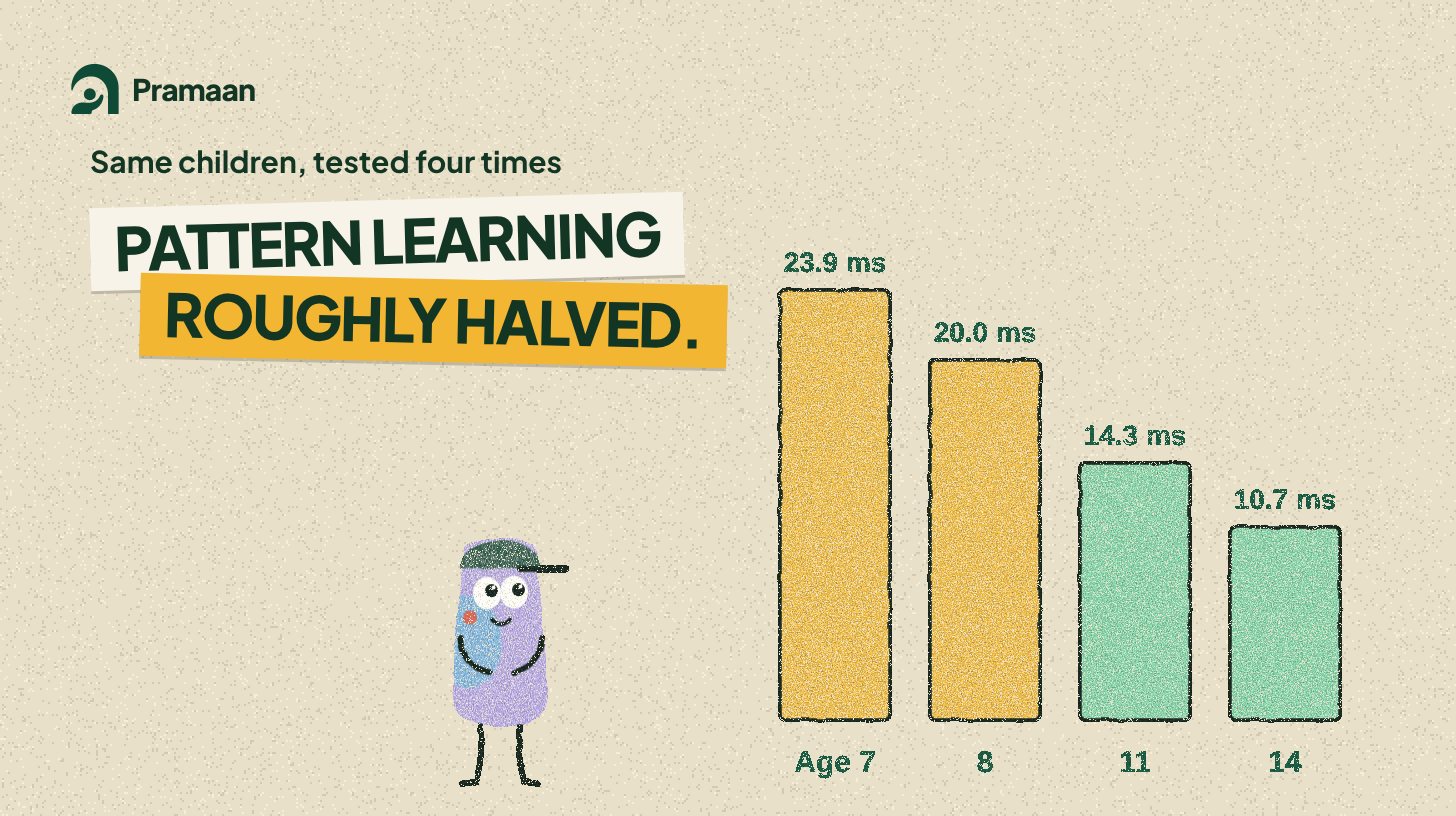
On average, pattern learning went down as children grew up. The team's model put the learning score at 23.9 milliseconds at age 7, 20.0 at 8, 14.3 at 11 and 10.7 at 14. In the raw data, scores at 7 were nearly twice those at 14.
This matches earlier work. In 2012, Janacsek, then at the University of Szeged, with József Fiser of Brandeis University and Dezső Németh, tested 421 people aged 4 to 85 on the same kind of task. Hidden pattern learning was strongest in childhood and dropped sharply around age 12. That was a snapshot of different people at different ages. The new study is stronger because it follows the same children, so we can see the change happen inside one life.
The interesting twist came at age 14, when the children also took tests of planning, working memory and verbal fluency, the deliberate thinking skills researchers call executive functions. Children with higher verbal fluency at 14 were more likely to be in the group whose pattern learning had declined than in the group whose learning improved. The authors' reading is that as children lean more on their own rules, plans and mental models, they become a little less sensitive to raw patterns in the world.
And not everyone followed the average.
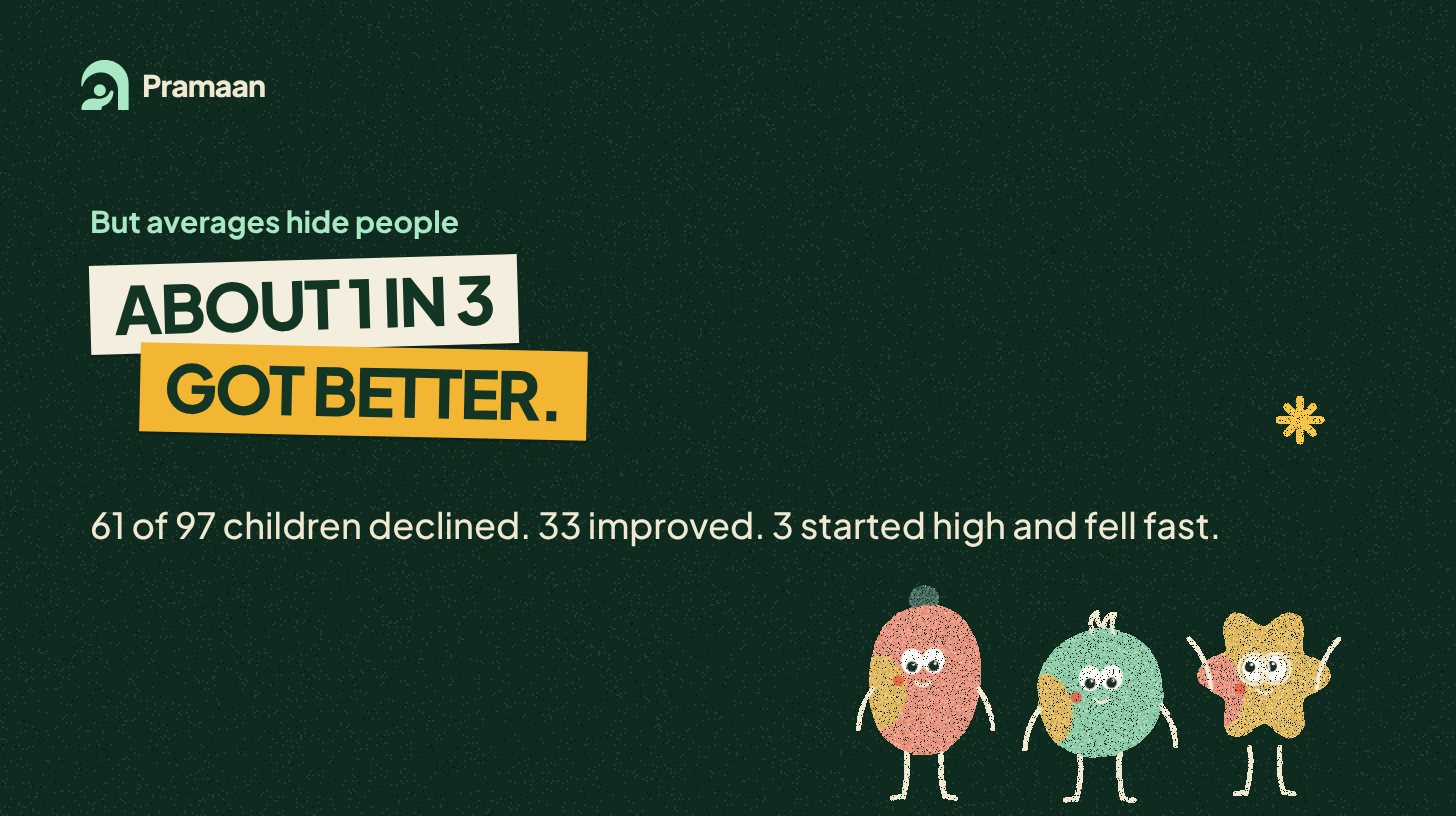
The team found three paths: 61 children whose pattern learning declined, 33 whose learning improved, and 3 who started very high and fell steeply.
What it cannot tell us
This is one careful study, and it has real limits, which the authors spell out.
- It is a convenience sample of 97 children in one country, not a representative one.
- Executive functions were measured only once, at 14, so we cannot say which change caused which.
- The task measures one kind of pattern learning, pressing keys to pictures. It is not a test of intelligence, maths ability or how well a child does at school.
- The paths for individual children were less certain than the averages; some children could be sorted into a different group by a different method.
So nothing here says your 13-year-old is learning worse than they did at seven. It says the way they learn is shifting.
What this means at home
We read this as a trade, and a good one. Between 10 and 15, children are swapping some of their effortless pattern-soaking for something more powerful: the ability to state a rule, test it and argue about it. That is exactly the age when a child can be asked, "What do you think the rule is? How would you check?"
Three things follow for parents.
Ask for the rule out loud. A younger child may pick up a pattern without being able to say it. An older child gets more from naming it. When your child gets good at something, ask them to explain the trick to you.
Mix in some practice without explanations. Hidden pattern learning does not vanish at 14. Games, music, a new language through songs and films, and sports that need quick reactions all still feed it.
Don't judge by the average. One in three children in this study got better at pattern learning over the years. Children change at different speeds and in different directions. Comparing a child with a cousin, or with their younger self, tells you very little.
In our labs, children aged 10 to 15 work on real problems in teams, and the moment we look for is when a guess turns into a rule someone can say out loud and test. This study is a useful reminder of why that age is the right time for it.
Sources
- Tóth-Fáber, E., Farkas, B. C., Tánczos, T., Németh, D., ... Janacsek, K. (University of Greenwich and colleagues), Longitudinal evidence for decreasing statistical learning abilities across childhood, Nature Communications 17: 10471, 2026 (97 children tested at 7, 8, 11 and 14, Hungary)
- Janacsek, K. (University of Szeged), Fiser, J. (Brandeis University) and Nemeth, D. (Szeged and Georgetown), The best time to acquire new skills: age-related differences in implicit sequence learning across the human lifespan, Developmental Science, 2012 (421 participants aged 4 to 85)