 Pramaan

School at 9, not 8: what one extra hour did for 13-year-olds
A new randomised trial moved two classes to a later start. They slept 26 minutes more a night and did better on a test of self-control.
Picture your child at 6.15 on a school morning. The alarm has gone twice. They are upright, but nobody would call them awake.
Many Indian schools start early, and many children then add tuition, homework and a phone to the evening. A new study asks a question parents and principals argue about every year: if school simply started an hour later, would children use the hour to sleep, or would they just stay up later?
What the researchers did
The study comes from a team led by Stéphanie Mazza, a sleep and memory researcher at the Lyon Neuroscience Research Centre in France, working with economists from the Paris School of Economics. It was published in Scientific Reports in May 2026.
They worked with one public boarding school in rural France that serves students from poorer families. Four classes of Grade 7 and 8 students, average age about 13, all started at 8 a.m. in September and October. Then the school randomly picked two classes to start at 9 a.m. from November. The other two stayed at 8. The day still ended at the same time; the lost hour came out of free periods.
Students wore wrist trackers that recorded their sleep, filled in a sleepiness questionnaire and did two short computer tests, one for attention and one for self-control. Everything was measured before the change and again about six months later. Because the classes were picked at random, any difference that opened up between the groups is more likely to be caused by the start time than by something else.
What they found
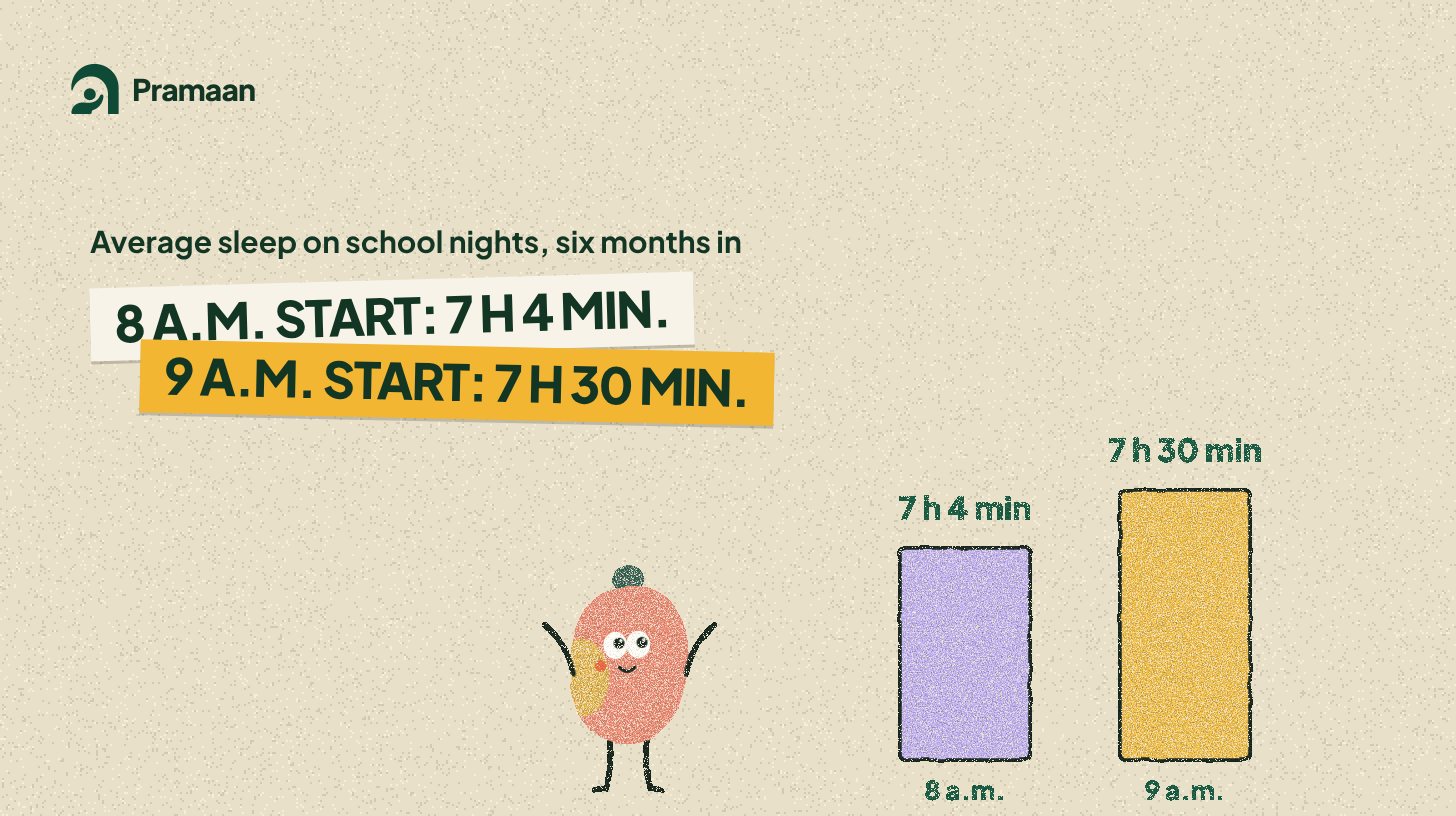
More sleep, not later nights. Six months in, the 9 a.m. group slept 26 minutes more a night on school nights: 7 hours 30 minutes against 7 hours 4 minutes. The children did not go to bed later. Their time of falling asleep did not differ between the groups. The extra hour in the morning turned into sleep.
Fewer very short nights. Half the 8 a.m. students slept less than 7 hours a night by the end. In the 9 a.m. group, it was 13 in 100.
Less sleepy. On the sleepiness questionnaire, the 8 a.m. group's scores rose by about 2 points on a 24-point scale over the months. The 9 a.m. group's did not move.
Better self-control. On the Stroop test, where you name the ink colour of a word like RED printed in blue, the 9 a.m. group improved by about 68 milliseconds more than the 8 a.m. group. That sounds tiny, but in a test like this it is a clear change. On the attention test the difference was smaller and not quite strong enough to count.

The students whose body clocks run late, the ones who naturally feel sleepy at midnight and alert at noon, gained the most: about 28 minutes a night.
What this study cannot tell us
It is small. Only four classes were randomised, and the self-control results come from 73 students, the sleep data from 50. Boys and the 8 a.m. group dropped out of wearing the trackers more often, which could tilt the results.
It is also a boarding school. Lights went out at 9.30 p.m., dinner was at a fixed time and nobody had a commute. In an ordinary home, with tuition at 7 p.m. and a phone under the pillow, a later start may not turn into sleep so neatly.
The study did not look at marks or exam results, and children who gained more sleep were not, one by one, the same children who gained most in self-control. The authors themselves point out that even at 9 a.m., most of these 13-year-olds slept less than they need, so a later bell alone is not enough.
Does it fit with other research?
Yes. A 2017 review in the journal Sleep Health by the researchers Bowers and Moyer pooled earlier studies of later school starts and found students gained about 20 minutes of sleep on average, according to the new paper's summary of it. In February 2026, a team at University Children's Hospital Zurich reported on a Swiss school that let students choose a later start: 95% chose it, and on school days they slept about 45 minutes longer. That was one school with no comparison group, so it is weaker evidence, but it points the same way.
What it means at home
Most of us cannot move the school bell. What this study suggests is that the time a child gets to sleep in the morning matters, and that the evening is where families still have room. If your child is up before 6.30 and asleep after 11, they are probably in the group that slept less than 7 hours. The useful question is where the extra half hour can come from: a phone that charges outside the bedroom, tuition moved earlier, or homework started before dinner rather than after.
And if you ever get a say in your school's timetable, this is a study worth bringing to the meeting.
Sources
- Reynaud, Malevergne, Rey, Grellet, Gurgand, Pawlik and Mazza, Lyon Neuroscience Research Centre and Paris School of Economics, A one-hour delayed school start improves sleep, sleepiness and inhibitory control in early adolescents in a randomized controlled trial, Scientific Reports, May 2026 (4 classes, Grades 7 and 8, 73 students; full text on PubMed Central)
- Bowers and Moyer, Effects of school start time on students' sleep duration, daytime sleepiness, and attendance: a meta-analysis, Sleep Health, 2017
- University of Zurich news, Later school start lets young people sleep longer, 26 Feb 2026 (Albrecht, Jenni, Huber et al., Journal of Adolescent Health; 754 responses, one school)