 Pramaan

Pen or keyboard: which helps your child learn more?
Brain scans, a letter-learning study and a famous note-taking replication point in different directions. Here is what each one actually found.
The worksheet arrives on the school app. The project gets typed. By Class 7, some children write more with their thumbs than with a pencil. So parents ask us a fair question: does it matter whether a child learns by writing by hand or by typing?
It depends on what the child is trying to learn. The research comes in three kinds, and they don't all say the same thing.
What the brain scans show
The study you may have seen in the news came from Audrey van der Meer and Ruud van der Weel, neuroscientists at the Developmental Neuroscience Laboratory at the Norwegian University of Science and Technology (NTNU) in Trondheim. In a paper in Frontiers in Psychology in January 2024, they asked 36 university students to write words they saw on a screen, sometimes in cursive with a digital pen on a touchscreen, sometimes by typing with one finger, while a cap of 256 sensors recorded their brain activity.
Writing by hand produced far more widespread connections between brain regions, mostly in the parietal and central areas and in the slower theta and alpha rhythms that researchers link with memory and learning. Typing produced much less.
An earlier study from the same lab, published in 2020 by Eva Ose Askvik with van der Weel and van der Meer, ran a similar test on 12 young adults and 12 children aged 12. The children showed the same pattern as the adults, only weaker.
Two cautions matter here. First, both studies are small. Second, neither measured learning. They show that the brain is busier during handwriting, not that a child remembers more afterwards. A busier brain is a promising sign, not a test score.
What happened when children learned new letters
For learning itself, the best recent evidence comes from Spain. Gorka Ibaibarriaga and Joana Acha of the University of the Basque Country and Manuel Perea of the University of Valencia taught 50 kindergarten children, about five years old, nine letters from the Georgian and Armenian alphabets and 16 made-up words. Some children practised by copying or tracing the letters by hand. Others practised by typing them on a keyboard.
The paper, published in the Journal of Experimental Child Psychology in 2025, found large differences. After three short sessions, children who practised by hand could name about nine in ten of the new letters (92%), against about three in four (76%) for those who typed. Asked to write the new words from memory, the handwriting groups got about 69% right. The typing groups got about 8%. Copying freehand also beat tracing.
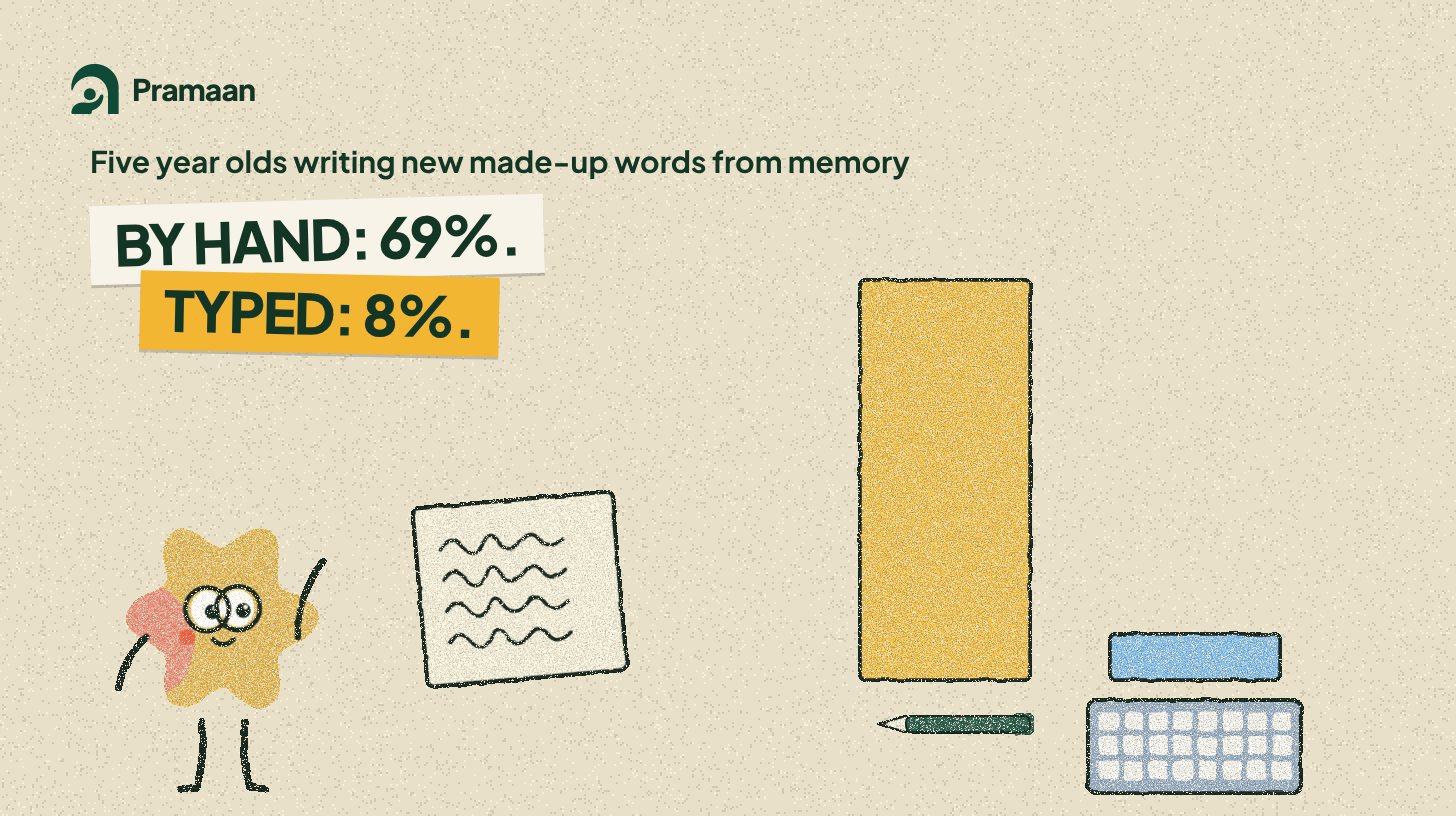
The authors are careful about the limits: 12 or 13 children per group, a brief training, and tests given straight away, so we don't know how long the advantage lasts. The children were also very new to keyboards. Still, for one job, learning the shapes and sounds of new symbols, the gap is too large to wave away.
That job is not only for five year olds. A 12 year old meeting the Greek letters of science, chemical symbols, a new script in a third language or the notation of algebra is doing a version of it.
What happened with lecture notes
The third kind of evidence is the one most relevant to older children: taking notes. In 2014, Pam Mueller of Princeton University and Daniel Oppenheimer of the University of California, Los Angeles, reported in Psychological Science that students who took laptop notes did worse on conceptual questions than students who wrote by hand. Laptop users typed more, and copied more of the lecture word for word. The study, of 67 Princeton students in its first experiment, was cited widely.
In 2021, Heather Urry and colleagues at Tufts University repeated it carefully with 142 students. Laptop notes were again longer and more word for word. But this time the laptop group did not score lower on the quiz. Across both studies, students who wrote more words tended to score higher. When the team pooled eight similar studies, the medium on its own did not make a reliable difference.
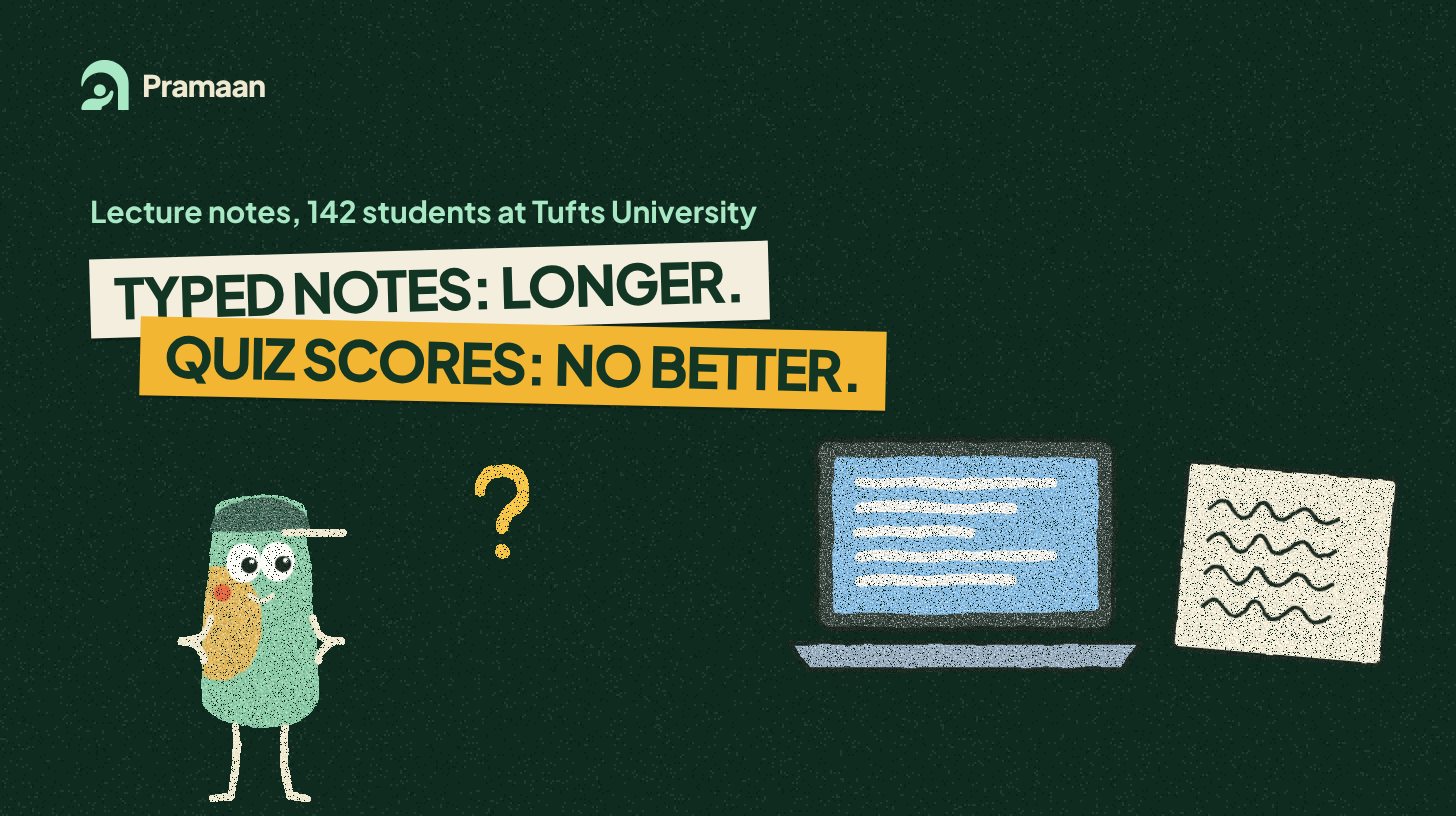
So for notes, the pen is not magic. What seems to matter more is whether a child is thinking while they write: choosing words, compressing, putting an idea in their own language. Typing makes it easy to skip that step. Handwriting makes it harder to skip, because no one can write as fast as a teacher talks.
What this means at home
Putting the three together, here is how we read it.
- When your child is learning something new to recognise and produce, such as letters in a new script, symbols, spellings or formulas, writing by hand is the better bet.
- When your child is taking notes, the tool matters less than the habit. Ask for notes in their own words, not a transcript.
- When the task is getting a long piece of work down, typing is fine and often faster. In both note-taking studies, typists wrote more, and writing more, in your own words, went with better scores.
None of this is a reason to ban the laptop. It is a reason to keep a pencil in the house, and to notice which kind of learning your child is doing before choosing the tool.
At Pramaan, children aged 10 to 15 work in teams on real problems, and a lot of the thinking happens on paper first: sketches, rough sums, labelled drawings. We don't think of that as old-fashioned. It is the slow step where an idea gets put into a child's own words.
Sources
- Van der Weel and Van der Meer, NTNU, Frontiers in Psychology, 2024 (36 university students, EEG; handwriting vs typing)
- Askvik, Van der Weel and Van der Meer, NTNU, Frontiers in Psychology, 2020 (12 young adults, 12 children aged 12, EEG)
- Ibaibarriaga, Acha and Perea, University of the Basque Country and University of Valencia, Journal of Experimental Child Psychology, 2025 (50 kindergarten children)
- Mueller and Oppenheimer, Princeton University and UCLA, Psychological Science, 2014 (Study 1: 67 students)
- Urry et al., Tufts University, Psychological Science, 2021 (142 students; mini meta-analysis of 8 studies)