 Pramaan

2, 4, 6: the dinner game that teaches children to test their ideas
Most clever adults fail this number puzzle. Why they fail, and the one move that fixes it, is worth teaching a child early.
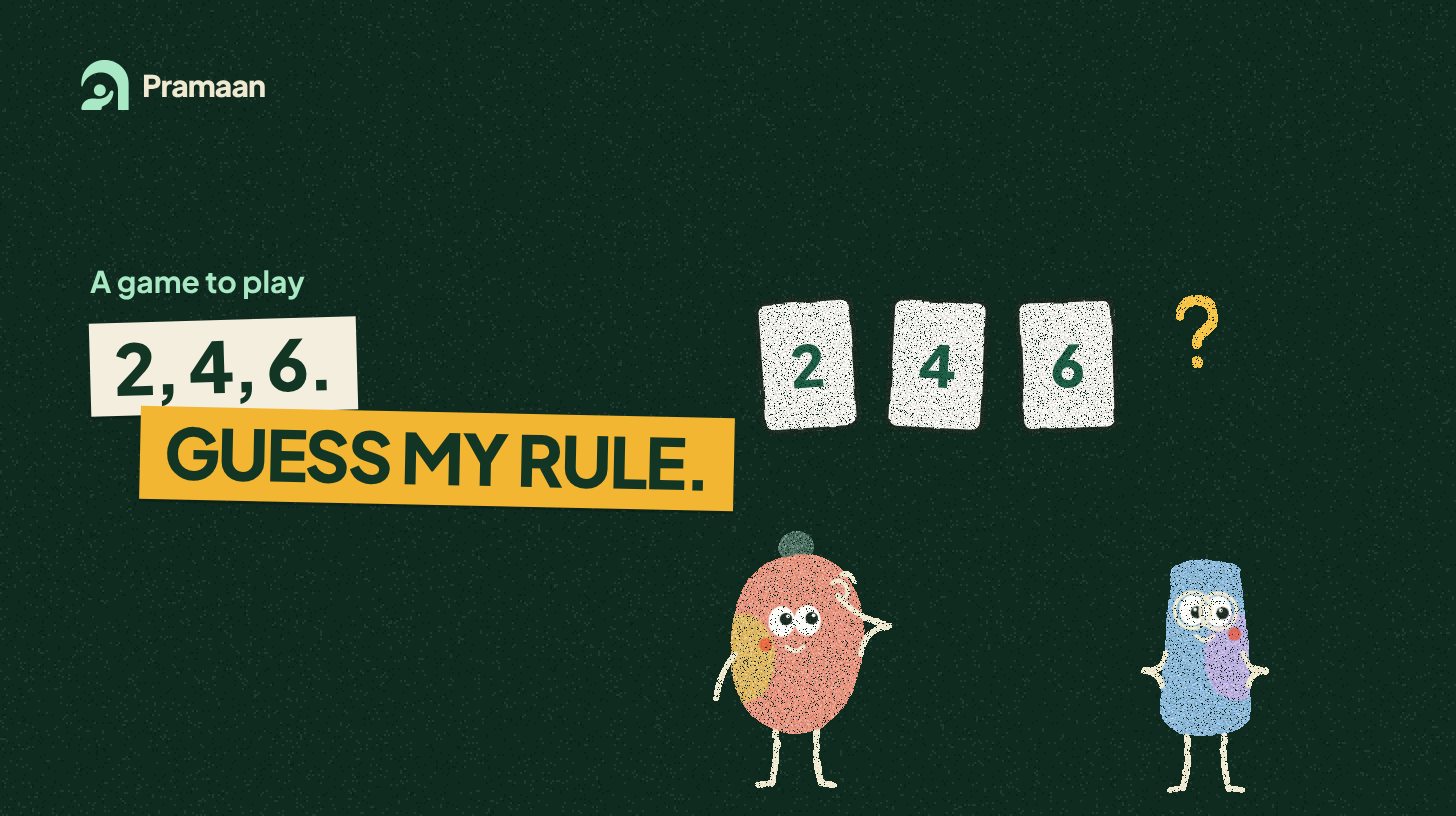
Here is a puzzle you can set at dinner tonight. Write three numbers on a scrap of paper: 2, 4, 6. Tell the table: "These three numbers follow a rule I'm thinking of. Find the rule. You can test any three numbers you like, and I'll tell you if they fit. When you're sure, say the rule."
Most people, adults included, start the same way. They try 8, 10, 12. It fits. They try 20, 22, 24. It fits. Feeling clever, they announce: "Even numbers going up by two." Wrong.
The rule, in the original version of this puzzle, is simply any three numbers in increasing order. So 1, 2, 3 fits. So does 5, 17, 300. Their guess was not silly. Every test they ran agreed with it. That is exactly the trap.
Where the puzzle comes from
Peter Wason, a psychologist at University College London, published this task in 1960 in the Quarterly Journal of Experimental Psychology. He gave it to 29 university students he described as intelligent young adults. Only 6 of the 29 named the correct rule without first announcing a wrong one. Thirteen made one wrong announcement, nine made two or more, and one never reached a conclusion.
What separated them was not maths. It was the kind of test they chose. Most people only tried triples they expected to fit, which can never show that a guess is too narrow. Wason noticed that the students who announced wrong rules again and again were, in his words, "unable, or unwilling to test their hypotheses".
This is a small study, run with university students more than sixty years ago, and it does not tell us how many 12 year olds would solve it. What it captures is a habit we all share: we look for evidence that agrees with us.
The twist that helps
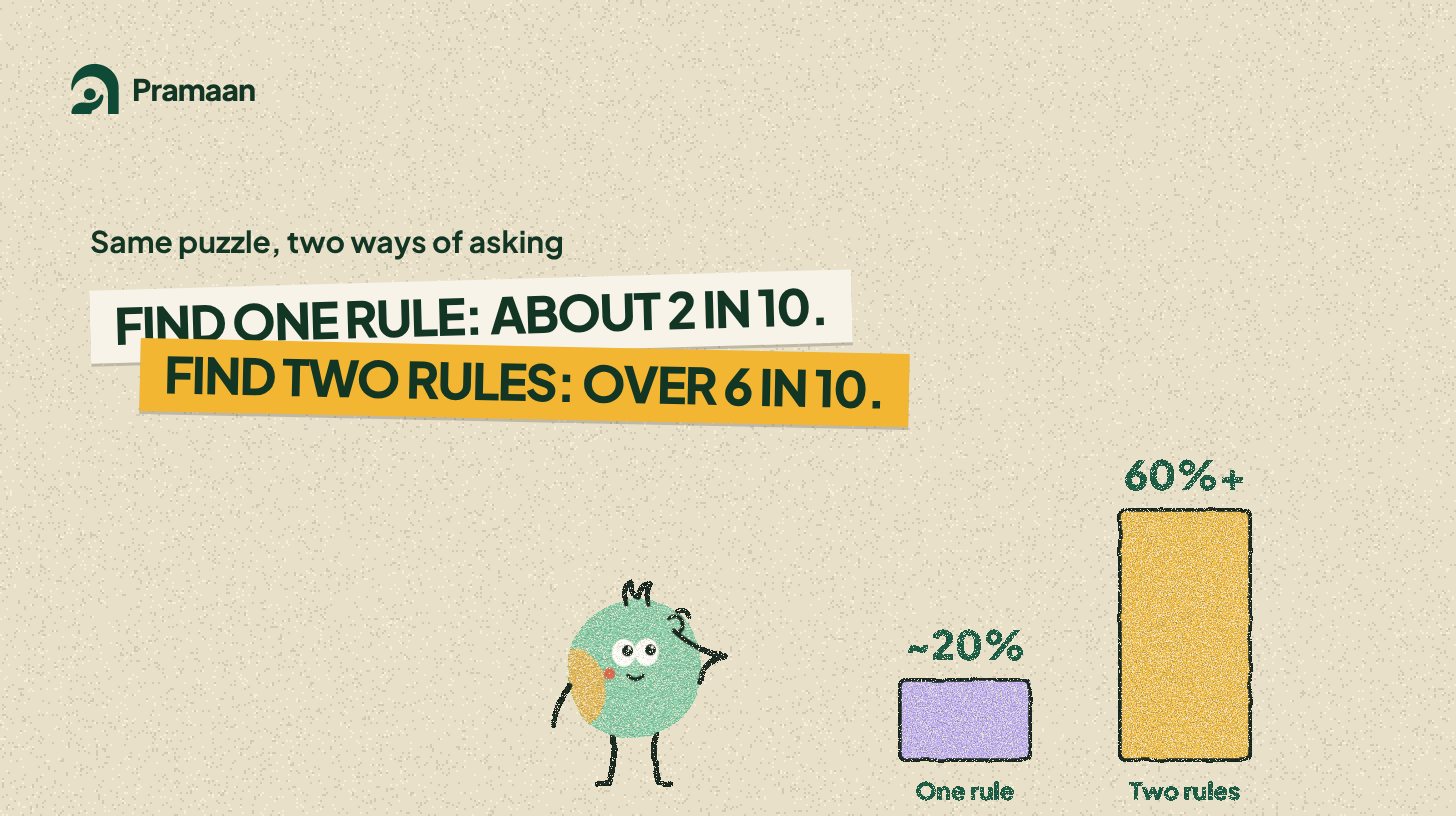
Later researchers asked a useful question: can a small change in how the puzzle is framed help people escape the trap? In a 2006 study in the same journal, Lancaster University psychologists M. Gale and Linden Ball compared the standard task with a "dual-goal" version. Instead of finding one rule, people were told there were two rules, one for triples that fit and one for triples that don't, and they had to find both.
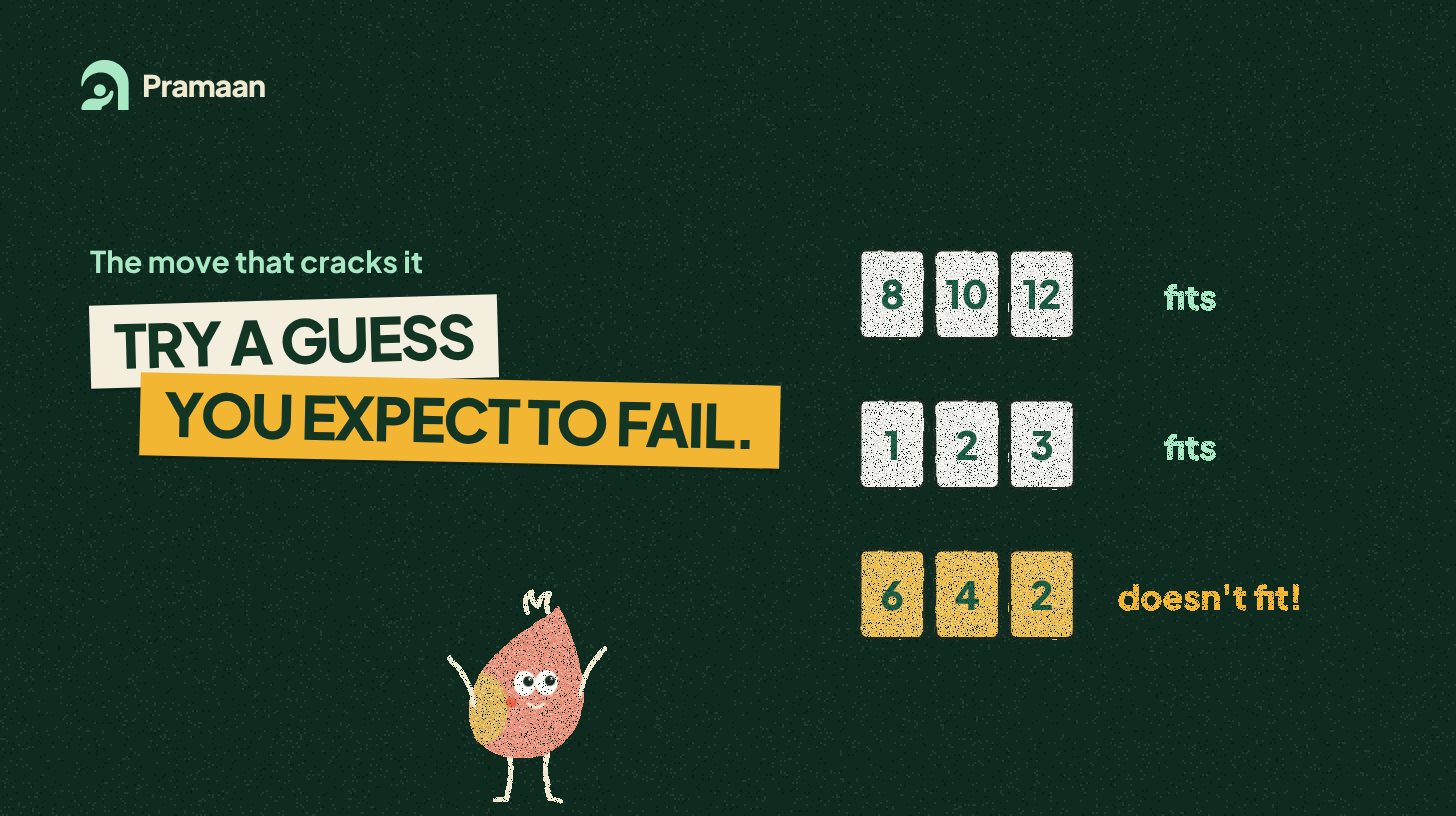
The standard version produces success rates of about 20%. The two-rule version raises them to over 60%. When Gale and Ball looked at what the successful people did differently, one move stood out: producing at least one descending triple, something like 6, 4, 2. Thinking about the numbers that don't fit pushed people to test the edges of their idea.
The studies were run with adults, and a puzzle at a dinner table is not a laboratory. We share them because the lesson travels well: a guess you never try to break is a guess you never really test.
Why we like it for children aged 10 to 15
At this age children are starting experiments in science class, reading charts and forming strong opinions about everything from cricket to climate. The 2, 4, 6 game trains three small habits that sit under all of that:
- Commit to a guess before you look it up. Your child has to say a rule out loud.
- Test to break, not to confirm. The best question is the one whose answer might be "no".
- Being wrong is information. A "doesn't fit" is the most useful answer in the game.
None of this needs a screen, a kit or a correct answer key beyond the rule in your head.
How to play
You need paper, a pen and two or more players. One person is the rule keeper.
- The keeper writes a rule secretly and shows one example triple that fits. Start with the classic: rule "any three numbers going up", example 2, 4, 6.
- Players take turns testing a triple. The keeper says only "fits" or "doesn't fit". Write every test down in two columns.
- Anyone can announce a rule once per round. A wrong announcement costs a point. A right one wins the round.
- Bonus point for any test that gets a "doesn't fit". This rewards brave tests.
- Swap keepers. Let your child invent the next rule. Good ones to try: "the middle number is the biggest", "all three are different", "the numbers add up to less than 20".
One question to ask while you play: "Do you want to try one you think will fail?" That single nudge is the move Gale and Ball found in the people who cracked it.
What to listen for
The moment worth noticing is not the win. It is when your child, unprompted, says "Let me try 9, 3, 1 just to check." That is the sound of someone testing an idea instead of defending it. It shows up later in a science project, in a debate and in a forwarded message they decide not to believe.
Sources
- Wason PC, University College London, Quarterly Journal of Experimental Psychology, 1960: On the failure to eliminate hypotheses in a conceptual task (29 students; 6 correct with no previous incorrect announcement)
- Gale M and Ball LJ, Lancaster University, Quarterly Journal of Experimental Psychology, 2006: Dual-goal facilitation in Wason's 2-4-6 task (standard about 20%, dual-goal over 60%; a descending triple mediates success)