 Pramaan

How much food does a city of one crore eat in a day?
A problem from our labs, the estimation trick hiding inside it, and a version to try at the dinner table tonight.
On 16 July 1945, the physicist Enrico Fermi lay about 16 kilometres from the first atomic test in the New Mexico desert, holding some small scraps of paper. When the blast wave reached him, he let them fall and watched how far they were pushed. From that one rough measurement he worked out the size of the explosion in his head: about 10 kilotons.
J. I. Katz, a physicist at Washington University in St. Louis, revisited the episode in a 2021 paper. Modern estimates put the yield at roughly 21 to 25 kilotons, so Fermi was out by about half. But he was in the right range, from a handful of paper and a few lines of reasoning, while the instruments were still being read.
That habit, getting a usable answer from very little, has a name: a Fermi problem. One of the problems in our labs is a Fermi problem dressed up as a city.
The problem
Imagine a city of one crore people. Every morning it wakes up hungry. How much food has to arrive, every single day, to feed it?
Nobody has that number in their head, and that is why it works. Teams cannot look it up and copy it down. They have to build it from things they can guess, check and argue about. We give them the question and a few facts, and let them work it out.
Below is the knowledge hiding inside the problem, and how a family can do the same thinking at home.
Start with one person, not one crore
One crore is too big to picture. One person eating for one month is not. So the first move is to shrink the problem.
Take cereals: rice, wheat, millets. India's household consumption surveys measure how much people actually eat. An analysis by the Centre for Economic Data and Analysis at Ashoka University, using the government's 2023-24 survey, puts it at about 8 kg of cereals per person per month in cities and 9.4 kg in villages. That number has been falling for years as diets shift towards milk, eggs, fruit and packaged food.
Now scale it back up:
- 8 kg × 1 crore people = 8 crore kg a month
- 8 crore kg is 80,000 tonnes
- spread over 30 days, that is about 2,700 tonnes of cereal a day
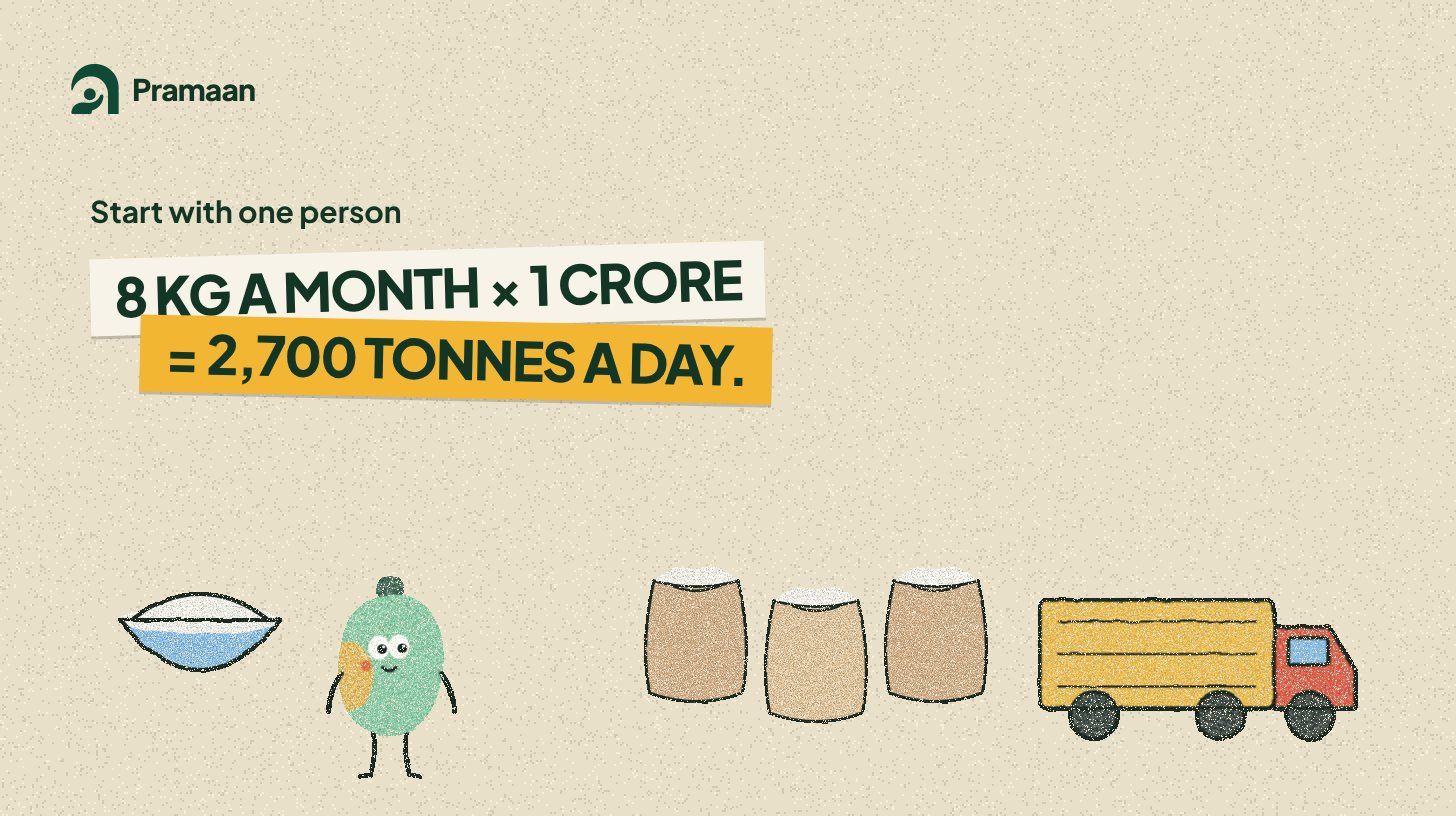
Each step is simple multiplication. Children rarely trip on the arithmetic. They trip on the units. A crore of kilograms becomes tens of thousands of tonnes, and a tonne is a thousand kilograms. Getting a team to say each number aloud with its unit catches most mistakes before they grow.
Then the trucks
Food does not teleport. Say a loaded truck carries about 10 tonnes of grain. That is our assumption, and a team should say so out loud. Then 2,700 tonnes means about 270 truckloads a day, just for cereals, before a single vegetable, litre of milk or packet of biscuits.
Change the assumption to 15 tonnes a truck and you get 180 trucks. That is fine. A Fermi answer is a range with reasons, and the reasons are what you check. If someone in the family drives past a mandi or a wholesale market, they now have something to look for.
What gets lost on the way
Here the problem turns into economics. A city does not only need what it eats. It needs what it eats plus everything lost between the field and the plate.
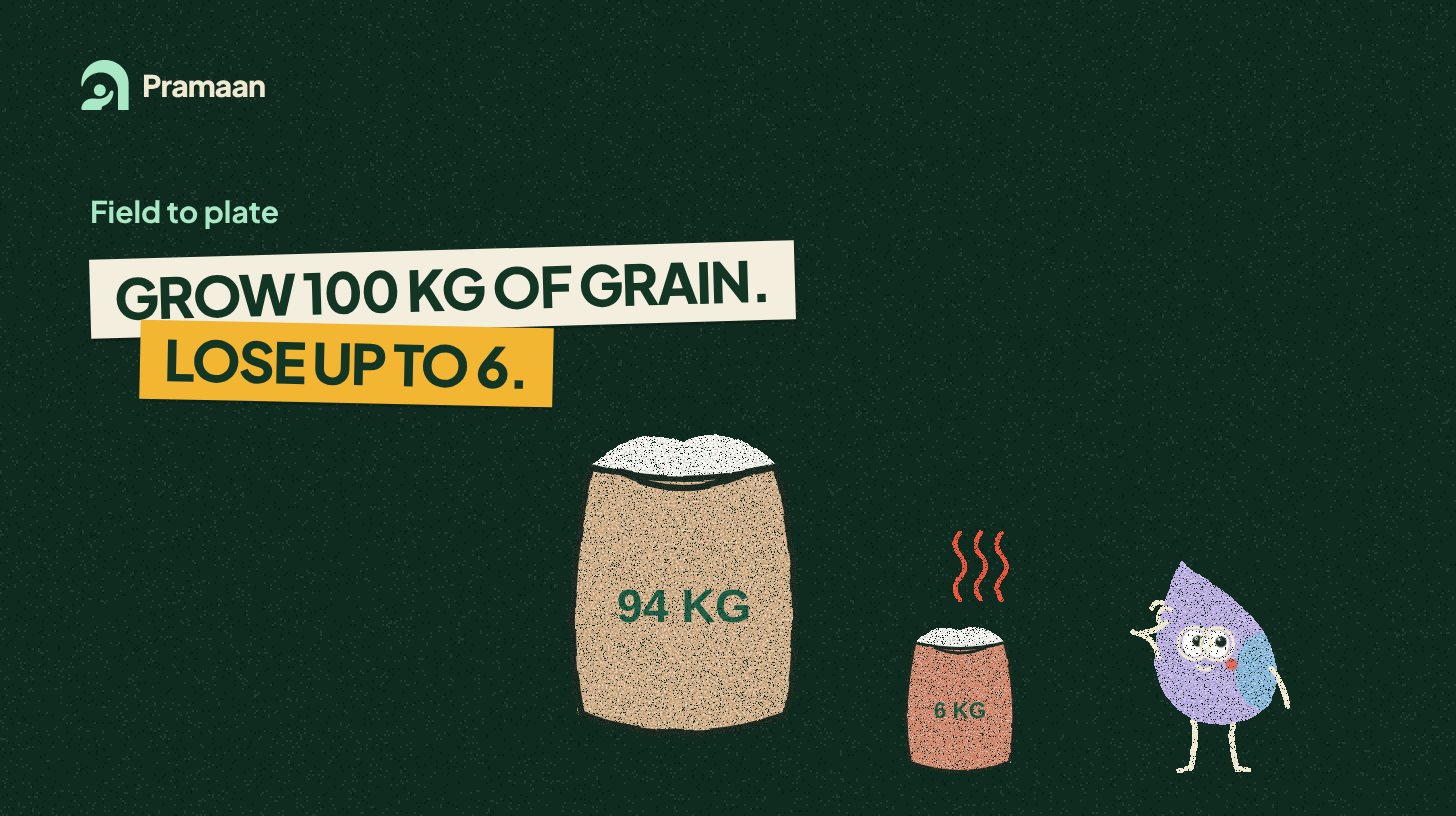
In 2022, NABCONS, a consultancy arm of NABARD, carried out a national study of harvest and post-harvest losses for the Ministry of Food Processing Industries. The government shared its estimates with the Lok Sabha in August 2024:
- cereals: 3.89% to 5.92% lost
- pulses: 5.65% to 6.74%
- vegetables: 4.87% to 11.61%
- fruits: 6.02% to 15.05%
For our city, losing about 5 in every 100 kilograms of grain means farms have to grow roughly 140 extra tonnes a day just to cover the gap. For vegetables, which bruise, wilt and rot, the loss can be more than twice that share.
This is where teams start to disagree in useful ways. Is it cheaper to grow more, or to lose less? A cold store costs money. So does a wasted harvest. Who pays for each, the farmer, the trader or the family buying tomatoes? There is no single right answer, and children aged 10 to 15 are well able to argue about it with numbers.
Why this kind of problem suits children
Lluís Albarracín and Núria Gorgorió, mathematics education researchers at the Autonomous University of Barcelona, studied how students aged 12 to 16 plan their way through Fermi problems involving large numbers, published in Educational Studies in Mathematics in 2014. They found students reaching for a range of strategies on their own: comparing with a reference they knew, splitting a space into a grid, working out a density, shrinking the problem to a smaller version, using a proportion. Their conclusion was modest: these problems are a good place to talk about how to tackle a problem at all.
That matches what Fermi problems ask of anyone. There is no formula to recall. You have to decide what matters, make an assumption you can defend, and notice when an answer is absurd. A team that gets 27 trucks a day for a crore people should feel that something is off, and go hunting for the lost zero.
Doing it at the dinner table
You do not need a city. A family is a small city with one kitchen. Start with something your child can see, like the atta tin or the rice bag, and work outwards.
You are after a number with a reason behind every step, and a child who can point to the step they trust least.
Sources
- Katz, Washington University in St. Louis and Los Alamos National Laboratory, Fermi at Trinity, arXiv preprint, 2021 (Fermi's estimate about 10 kilotons, about 16 km away; modern estimates about 21 to 25)
- Kulvinder Singh, CEDA, Ashoka University, Growing more, eating less: India's cereal consumption patterns, Feb 2025 (NSS household consumption surveys; 2023-24: about 9.4 kg rural, 8 kg urban per person per month)
- Down To Earth, As told to Parliament (August 6, 2024): NABCONS 2022 study of harvest and post-harvest losses (cereals 3.89 to 5.92%, pulses 5.65 to 6.74%, vegetables 4.87 to 11.61%, fruits 6.02 to 15.05%)
- Albarracín and Gorgorió, Autonomous University of Barcelona, Devising a plan to solve Fermi problems involving large numbers, Educational Studies in Mathematics, 2014 (students aged 12 to 16)