 Pramaan

Copy my build: a kitchen-table game that trains spatial thinking
Two players, a wall and six household objects. The game behind it, the research on spatial skills, and how to make it harder each week.
Ask a child to explain how to get from the school gate to their classroom without using their hands. Most give up on words within seconds and start pointing. Left, behind, on top of, upside down: these feel like easy words until you have to use them to put a picture into someone else's head.
That small struggle is a window into spatial thinking, the ability to hold a shape in your mind, turn it around and work out where things sit in relation to each other. It is what you use to pack a suitcase, read a map, follow a flat-pack diagram or picture how a gear turns. Below is a game that exercises it with things already in your kitchen, and the research on why it is worth a few evenings.
What the research says
The biggest review we know of comes from David Uttal, a psychologist at Northwestern University, with Nora Newcombe of Temple University and colleagues. Writing in Psychological Bulletin in 2013, they pooled 217 studies that tried to train spatial skills. Training worked, with an average effect size (Hedges' g) of 0.47. In plain terms, the average trained person ended up ahead of roughly two thirds of the untrained group. Two details matter for parents. The gains held when people were tested again weeks later, and they carried over to spatial tasks nobody had practised.
Why care? Jonathan Wai, then at Duke University, worked with David Lubinski and Camilla Benbow of Vanderbilt University to go back to Project Talent, a survey of about 400,000 American high-school students in grades 9 to 12 who were followed for 11 years. Their 2009 paper in the Journal of Educational Psychology found that spatial ability in the teenage years stood out among the people who later earned science and engineering degrees and worked in those fields. That is a link; it does not show that spatial skill caused the careers, and the students were Americans from the 1960s.
The closest finding to home is a 2022 review in Developmental Psychology by Zachary Hawes of the University of Toronto, Katie Gilligan-Lee of the University of Surrey and Kelly Mix of the University of Maryland. Across studies with about 3,700 people aged 3 to 20, spatial training also lifted mathematics scores. Training with real objects, such as blocks and puzzles, worked better than training on a screen. And the maths gains showed up in children older than seven, so this is not only a preschool idea.
A fair warning: none of these studies tested the game below. It borrows the ingredients the research keeps pointing to: real objects in the hand, precise words for space, and turning a picture around in your head.
How to play Copy My Build
You need two players, a table and a wall between them. A big atlas or a school bag standing upright works. Each player gets an identical set of six to eight household things, for example:
- one steel tumbler
- one matchbox
- two spoons
- one bottle cap
- one bangle
- one small book or notebook
- Player A, the builder, secretly arranges their objects into a small structure behind the wall. Start simple: everything flat on the table.
- Player A then describes it, in words only. No pointing over the wall, no drawing.
- Player B, the copier, builds from the description. They can ask as many questions as they like.
- When Player B says "done", lift the wall and compare.
- Swap roles and play again.
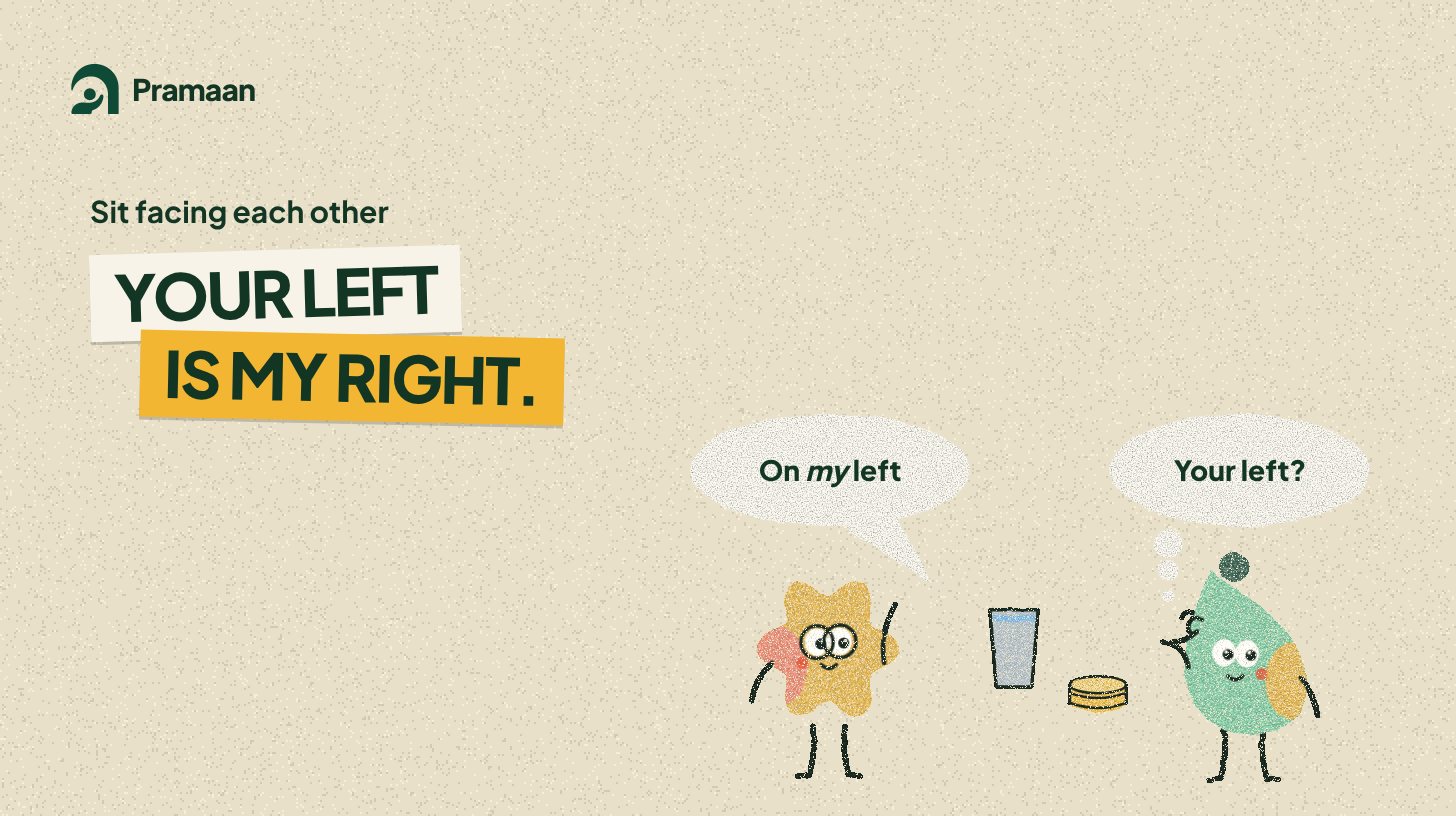
Sit facing each other, not side by side. That one choice makes the game harder in a useful way: your left is now the other person's right. A builder who says "put the spoon on the left" without thinking will get it wrong, and the fastest players learn to say "on your left" or to describe things from the copier's side of the table.
Make it harder
Once a round feels easy, change one rule at a time.
- Go up. Allow stacking. The tumbler upside down with the matchbox on top is already a test of words like open end and standing on its short side.
- Ban the easy words. No here, there or this one. Every position has to be described against something else.
- Turn it. After the build is finished, the builder describes it as if they had walked around to the other side of the table.
- Fewer questions. The copier gets only five questions. Now the builder has to plan the description before they start.
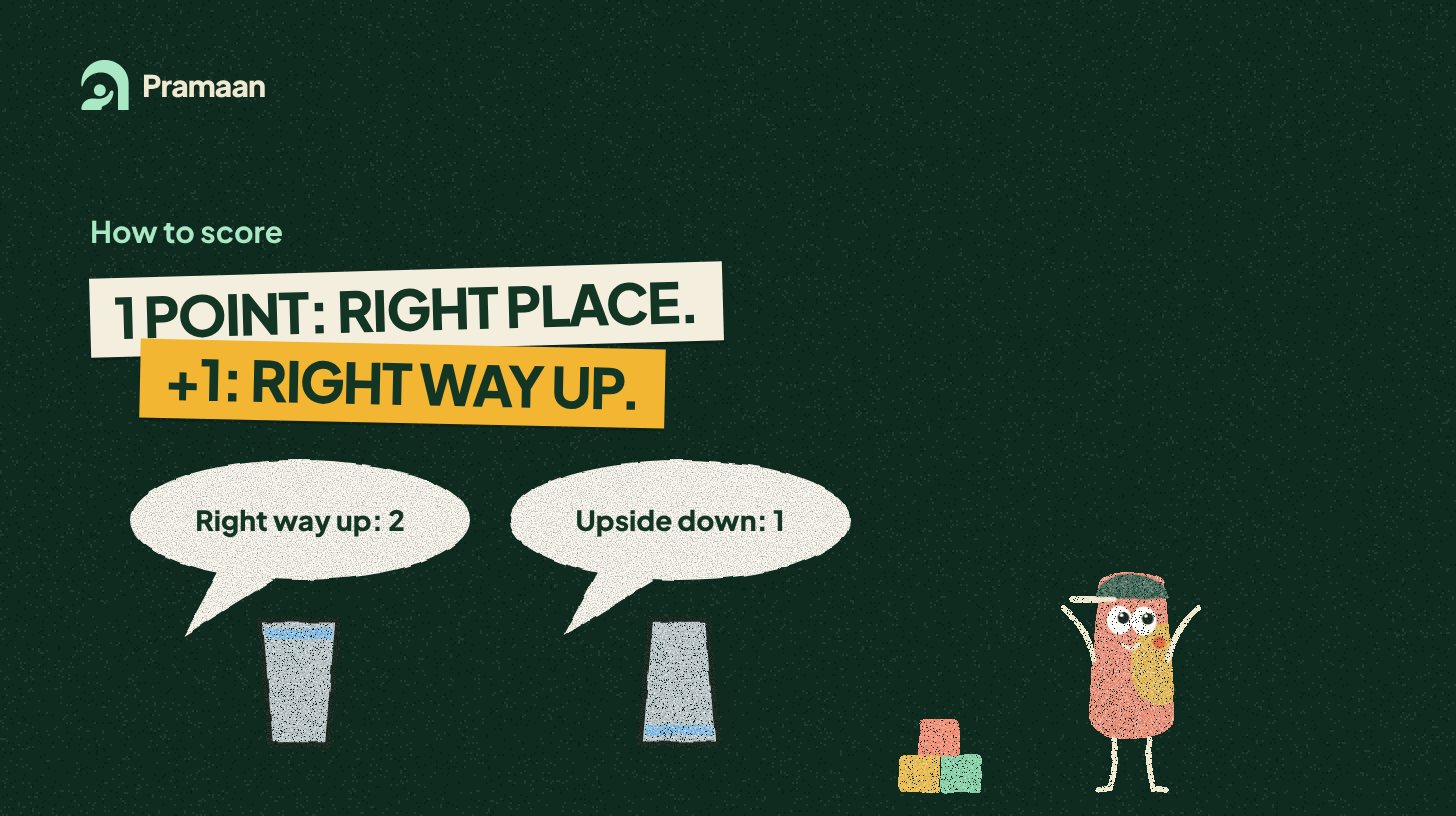
Score one point for each object in the right place and one more if it is the right way up. Keep a running tally on a sheet of paper over a week. Most families find the scores climb quickly once both players start agreeing on their own words for things.
What to listen for
Pay attention to the words, not the score. Early rounds are full of "that thing" and "next to it". Later rounds tend to bring in rotated, the handle facing you, a finger's width apart. Notice the moment your child stops describing from their own seat and starts describing from yours. That switch, taking someone else's point of view in space, is the part this game trains hardest.
When a copy goes wrong, resist fixing it mid-round. Lift the wall, look at both builds side by side and ask, "Which word would have saved us?" The answer usually lands on one missing word, and children remember it because it cost them points.
Why we like it
The problems children take on at Pramaan end with a working model that has to be explained to a room of people who did not build it. Turning a shape in your hands into words someone else can follow is half of that job, and this game practises it with a tumbler and two spoons.
Sources
- Uttal, Meadow, Tipton, Hand, Alden, Warren and Newcombe, Northwestern University and Temple University, Psychological Bulletin, 2013 (meta-analysis of 217 studies, g = 0.47)
- Wai, Lubinski and Benbow, Duke University and Vanderbilt University, Journal of Educational Psychology, 2009 (Project Talent, about 400,000 students in grades 9 to 12, followed 11 years)
- Hawes, Gilligan-Lee and Mix, University of Toronto, University of Surrey and University of Maryland, Developmental Psychology, 2022 (meta-analysis, about 3,700 participants aged 3 to 20), via ScienceDaily