 Pramaan

How would you cool a classroom with no AC?
Heat shut more schools than any other climate hazard in 2024. The physics, maths and money inside one of our lab problems, plus a version to try at home.

It is two in the afternoon in April. The fan is on, the windows are open, and the room is still hot enough that nobody is really listening. If you went to school in India, you remember this. Your child may be living it now.
In 2024, at least 242 million students in 85 countries had school disrupted by extreme climate events, according to UNICEF. South Asia was hit hardest, with 128 million students affected, and heatwaves were the main reason schools shut.
So here is a problem we give teams in our labs: cool a classroom by a few degrees, with no air conditioner and almost no money. It sounds like a building problem. It turns out to be physics, maths and economics in one room.
First, does heat really hurt learning?
It is fair to ask. A hot afternoon is unpleasant, but does it change what children actually learn?
A team of economists has looked at this in Indian data. Sumit Agarwal of the National University of Singapore, Pulak Ghosh of IIM Bangalore, Francesco Scarazzato of the Vienna University of Economics and Business, and Sofie Waltl of the University of Cambridge matched Class 8 exam results from 134,985 public schools in seven states (Andhra Pradesh, Arunachal Pradesh, Gujarat, Kerala, Madhya Pradesh, Maharashtra and Tamil Nadu) with the daily temperature near each school, across the school years 2014-15 to 2017-18.
Hotter school years went with fewer passes and fewer distinctions. By their estimate, even an optimistic warming of 0.64°C would mean about 3% fewer students passing. The effect was strongest on days above 40°C, rural schools were hit harder, and schools with more greenery around them did better.
Two cautions. This is a working paper, not yet peer-reviewed. And it measures the weather near a school, not the temperature inside a classroom, so it shows a strong link rather than proving exactly how heat does its damage. Still, the direction is clear, and it matches what any teacher in May could tell you.
Where the heat gets in
The first thing teams have to work out is where the heat comes from. A classroom gains heat in three ways.
- Radiation: sunlight hits the roof and walls and warms them. A thin tin or asbestos sheet heats up fast and then glows heat down onto the children below.
- Conduction: heat soaks through solid things, from the hot outer surface of the roof to its inner side.
- Convection: warm air rises and moves. If hot air pools near the ceiling with nowhere to go, the room stays hot.
Each way in suggests a way to fight back. You can reflect the sun before it lands, block the heat on its way through, or let the hot air out.
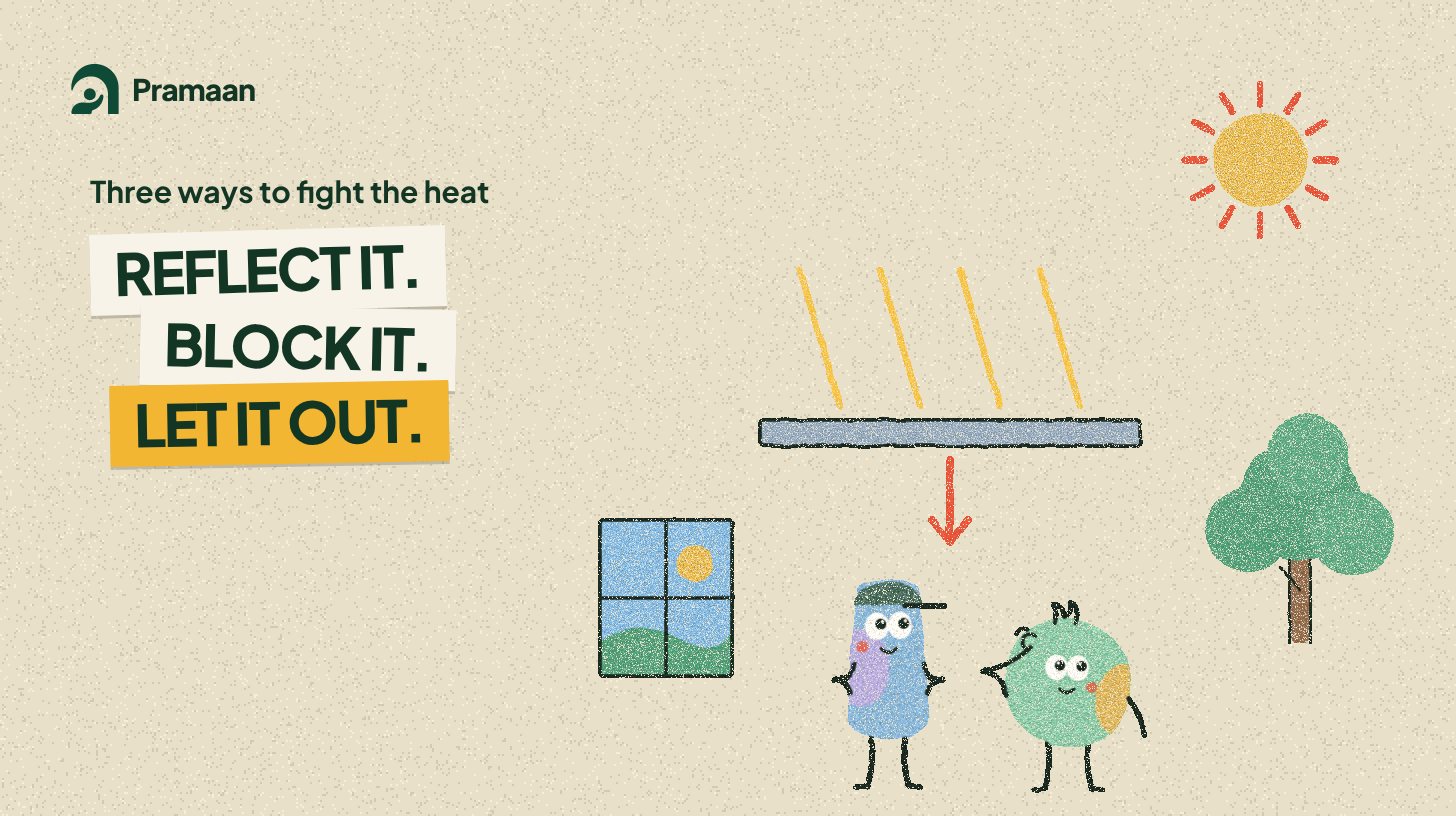
Reflect, block, let it out
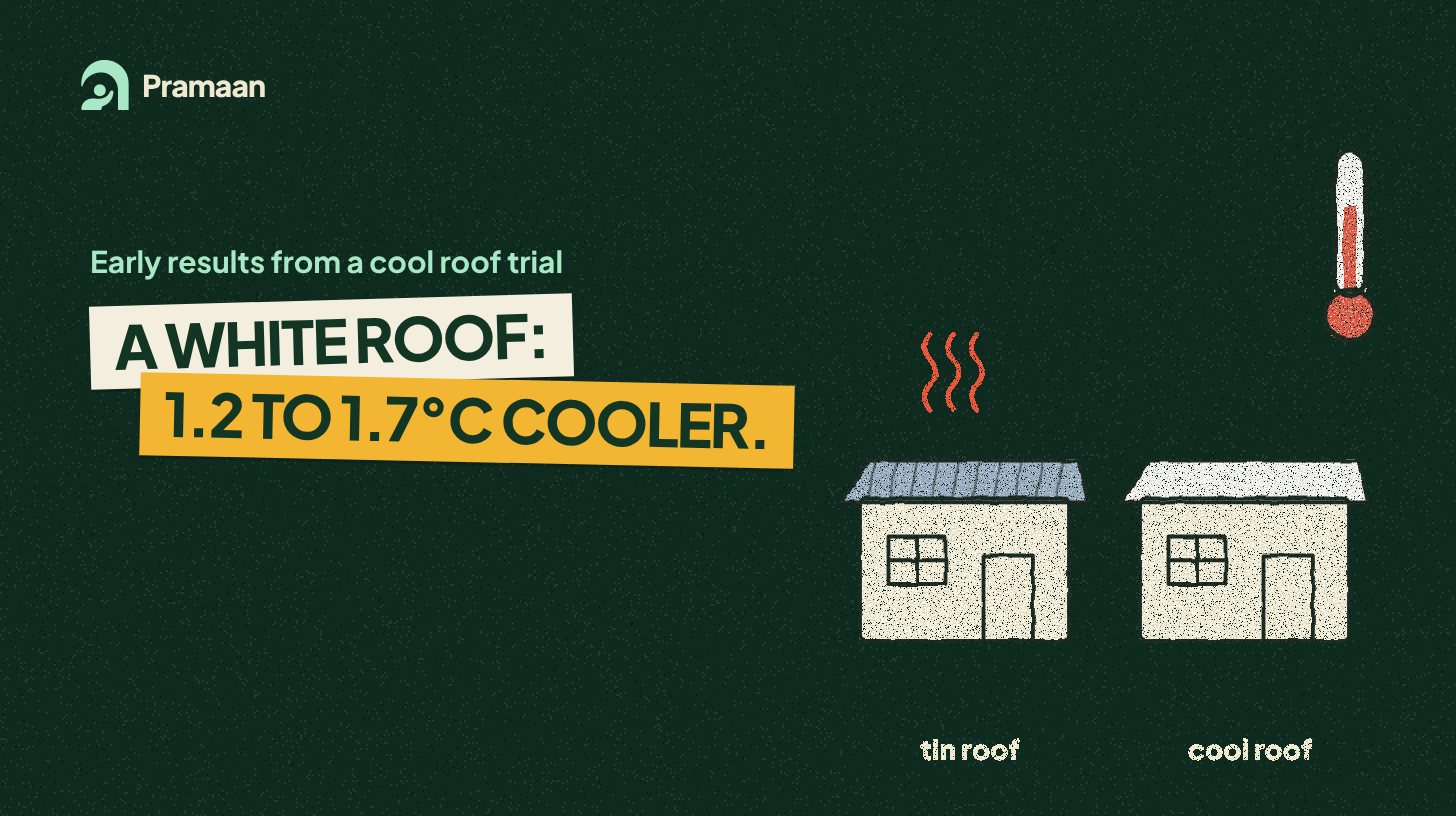
Reflect. A roof painted with a white, reflective coat sends much of the sunlight back up. Ahmedabad has run a cool roof programme for low-income homes since 2017, which had reached over 3,000 homes by 2022, according to the Natural Resources Defense Council.
How much cooler does it get inside? A trial led by Aditi Bunker, an epidemiologist at Heidelberg University, painted roofs in Burkina Faso and other countries. Its early results, reported by Reuters in 2025, found indoor temperatures 1.2°C lower in tin and mud-roofed homes and 1.7°C lower in tin-roofed homes over two years. The same team is now testing cool roofs in about 400 homes in Ahmedabad.
A degree or two may not sound like much. Look back at the exam study, though: a change smaller than a degree was enough to show up in pass rates.
Block. A false ceiling or a layer of insulation under a hot roof slows the heat on its way down. Trees and shade cloth on the sunny side do the same job for the walls and windows, which may be part of why greener schools did better in the exam data.
Let it out. Hot air rises, so an opening high on the wall lets it escape while cooler air comes in low on the other side. A ceiling fan helps children feel cooler by moving air over their skin, but it does not lower the temperature of the room.
The maths and the money
For a 12-year-old, this is the best part. Every fix costs something: paint, labour, a sheet of insulation, a sapling that takes three years to give shade. A school has a fixed budget and many rooms.
So teams have to compare ideas fairly. The useful question is not "which fix cools the most?" but "how many degrees do we get for every rupee, and for how many children?" A cheap coat of paint across every roof in a school may help more children than one expensive fix in one room. A tree costs almost nothing but works slowly. Getting to an answer means measuring, estimating and arguing with numbers, which is exactly the habit we want children to practise.
There is no single right answer, and that is what makes it a good problem. A school in coastal Kerala, with humid heat, needs something different from a school in dry Rajasthan.
Try the same thinking at home
You don't need a classroom to try this. Your own home has a hottest room, and your child can be the one who works out why, and what to do about it.
Sources
- UNICEF, Learning Interrupted: Global snapshot of climate-related school disruptions in 2024, press release, 23 January 2025 (242 million students, 85 countries; South Asia 128 million)
- Agarwal (NUS), Ghosh (IIM Bangalore), Scarazzato (WU Vienna) and Waltl (University of Cambridge), The Association between Adverse Temperature Shocks and Schooling Outcomes in India, Cambridge Land Economy working paper 2025-06 (134,985 public schools, 7 states, 2014-15 to 2017-18)
- Reuters via ThePrint, Indian slums get cool roofs to combat extreme heat, 10 March 2025 (Heidelberg-led trial: 1.2°C and 1.7°C lower indoors in Burkina Faso; about 400 homes in Ahmedabad)
- NRDC, GERMI and IIPH Gandhinagar, Addressing rising demand: India cool roofs fact sheet, November 2022 (Ahmedabad programme since 2017, over 3,000 low-income homes)