 Pramaan

Breakfast for 15 lakh more children. Does it help them learn?
Tamil Nadu now serves breakfast up to Class 8. What the research says about a morning meal and attention, and where it is still unsure.
What did your child eat before leaving for school today? In many Indian homes the honest answer on a rushed weekday is a cup of tea, a biscuit, or nothing at all until the tiffin opens at break.
Tamil Nadu has just made that question a matter of public policy. In September the state began serving a free hot breakfast to children in Classes 6 to 8, the same ages we work with at Pramaan. It is a good moment to ask what the research can and cannot tell us about a morning meal and learning.
What changed in September
On 22 September 2026, Chief Minister C. Joseph Vijay extended the Perunthalaivar Kamarajar Breakfast Scheme, which until then fed primary classes, to Classes 6 to 8. According to the state's announcement, about 15.3 lakh more students in 15,454 government and aided schools now get breakfast before lessons begin. The state added ₹217.63 crore this year, taking the scheme's budget to ₹724 crore. The menu rotates between upma, kichadi and pongal, with millets twice a week. Two districts, Chengalpattu and Tiruppur, were left out for now because of by-elections.
What the state's own study found
The scheme began in September 2022 with Classes 1 to 5. Tamil Nadu's State Planning Commission then followed about 5,300 primary children in 100 schools across all 38 districts, from December 2023 to December 2024, with fieldwork by the state's government medical colleges.
Over that year, the share of children who paid attention in class without being reminded rose from 85.8% to 93.7%. The share who could recall earlier lessons rose from 71.4% to 77%. Attendance moved from 89% to 90%.
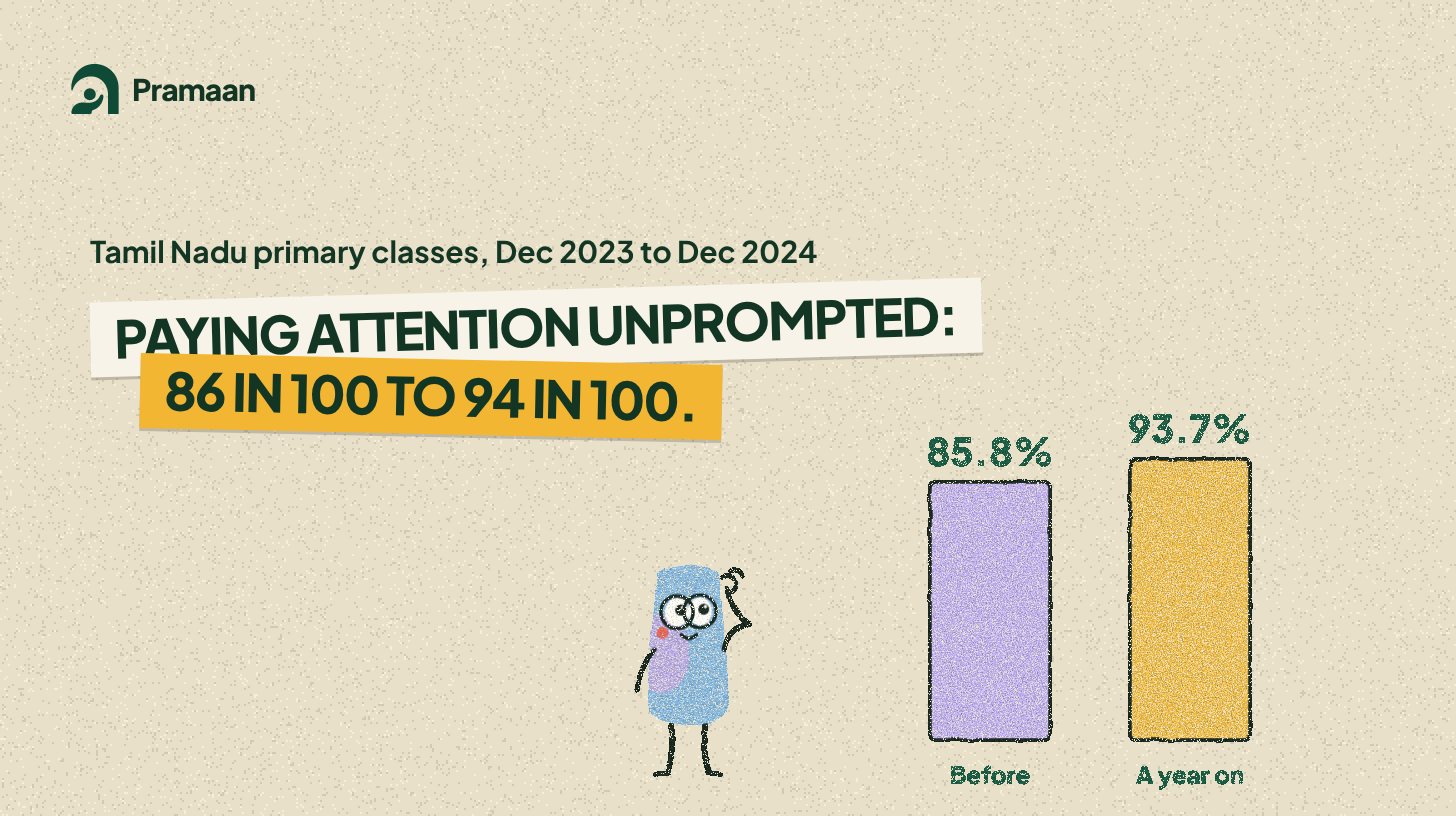
These are encouraging numbers, and we should read them carefully. The study had no comparison group of similar children who did not get breakfast. Every child in it was also a year older and a year further into school by the end. So the report tells us things improved while breakfast was served. It cannot tell us how much of that came from the breakfast.
The strongest Indian evidence is about lunch
For a cleaner answer, the best Indian study looks at the midday meal. Tanika Chakraborty, an economist at IIT Kanpur, and Rajshri Jayaraman, an economist at ESMT Berlin, used a natural experiment. After a 2001 Supreme Court order, states started serving cooked midday meals at different times between 2002 and 2006. That meant children of the same age had different numbers of years with a school meal, depending on their state and birth year.
Using ASER test data on about 12 lakh rural children aged 6 to 10, collected from 2005 to 2012, they found that children with up to five years of midday meals scored about 18% higher in reading (0.17 standard deviations) and about 9% higher in maths (0.09 standard deviations) than children with less than a year. The study appeared in the Journal of Development Economics in 2019.
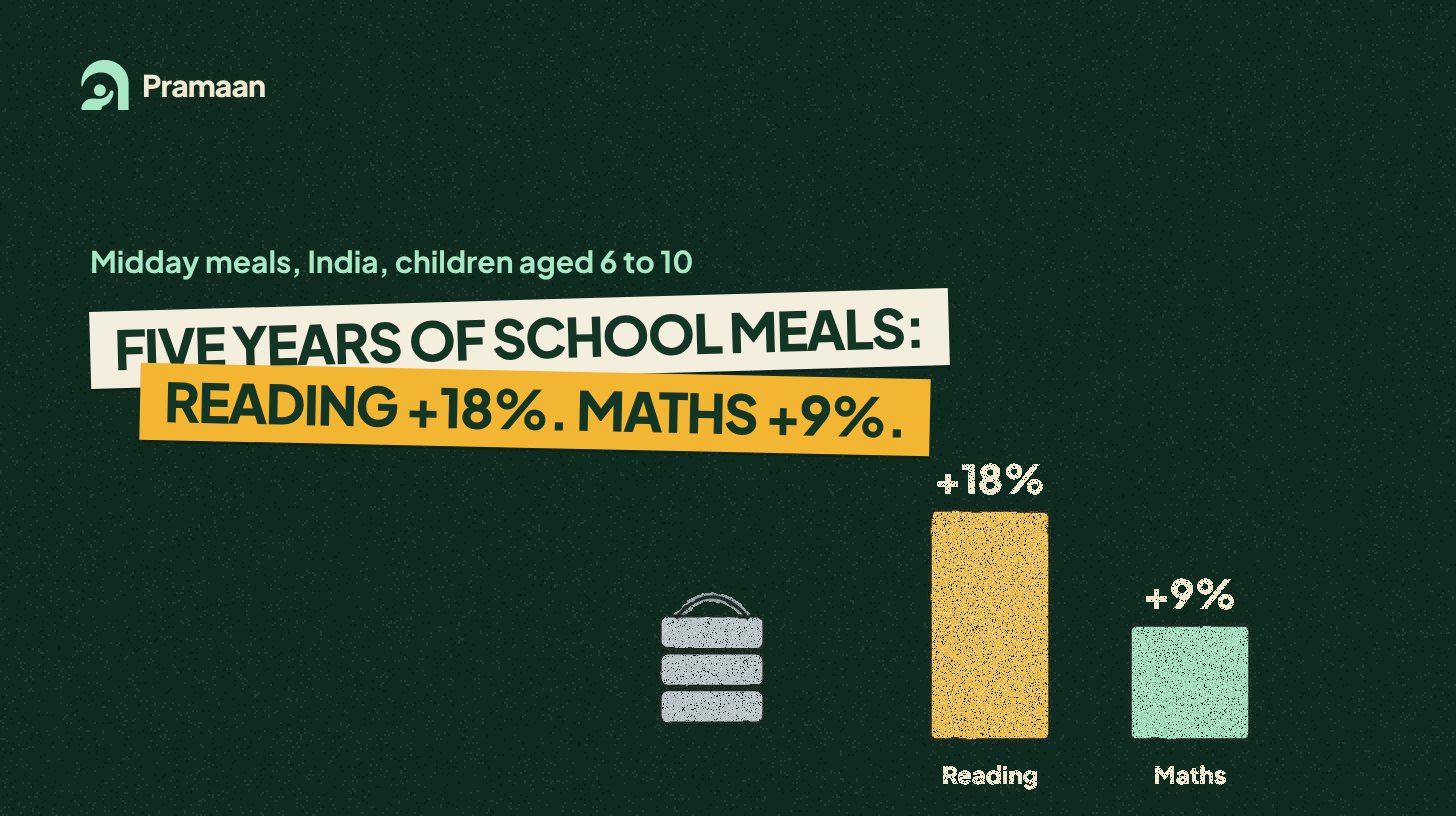
Two limits matter. This is lunch, not breakfast, and these were primary school children, not 12-year-olds. And the design rests on an assumption that states which started earlier were not already improving faster for other reasons, which the authors note cannot be tested directly.
What the lab studies say about breakfast itself
The most careful summary of breakfast experiments comes from Katie Adolphus, Clare Lawton, Claire Champ and Louise Dye at the University of Leeds' Human Appetite Research Unit. They reviewed 45 studies of children and adolescents aged 4 to 18, published in Advances in Nutrition in 2016.
Their conclusion was measured. Compared with skipping it, eating breakfast gave a short-term boost on the same morning, most reliably on tasks that need attention, planning and memory. The effect was clearer in undernourished children. On long-running school breakfast programmes and on which breakfast works best, they said firm conclusions could not be drawn, because the studies were few and inconsistent.
They also flagged gaps: very little research on adolescents, small samples, and tests done in labs more than in real classrooms. One more thing a careful reader should know: the review was commissioned and funded by Kellogg's.
What this means at home
Put together, the evidence points one way without shouting. A meal before school seems to help a child stay with a lesson through the morning, and the benefit is likely to be largest for children who would otherwise go hungry. It does not promise higher marks on its own, and nobody has shown that one particular breakfast is better than another.
For a 10 to 15 year old, the useful move is less about the menu and more about making breakfast happen on busy days. Children this age often skip it to sleep ten more minutes. Something simple counts: a bowl of poha or upma, an idli, curd and fruit, a roti from last night. If mornings are truly impossible, a filling snack eaten on the way is better than a long fast until break.
The more interesting question is one your child can answer for themselves, which brings us to tonight.
Sources
- News On AIR, 22 Sept 2026: Tamil Nadu CM expands Kamarajar Breakfast Scheme to benefit 15.3 lakh students (15,454 schools; ₹217.63 crore more, ₹724 crore total)
- PTI via Careers360, 22 Sept 2026: Tamil Nadu CM Vijay launches breakfast scheme expansion for Classes 6 to 8 (menu, kitchens, districts left out)
- ThePrint, 20 Mar 2025: Tamil Nadu State Planning Commission study of the breakfast scheme (100 schools, about 5,300 children, Dec 2023 to Dec 2024)
- Chakraborty and Jayaraman, IIT Kanpur and ESMT Berlin, School feeding and learning achievement: evidence from India's midday meal program, Journal of Development Economics 139, 2019 (about 12 lakh children, ASER 2005 to 2012)
- Chakraborty and Jayaraman, IZA Discussion Paper 10086, 2016 (working paper version with full results)
- Adolphus, Lawton, Champ and Dye, University of Leeds, The effects of breakfast and breakfast composition on cognition in children and adolescents: a systematic review, Advances in Nutrition, 2016 (45 studies, ages 4 to 18; funded by Kellogg's)