 Pramaan

What would a sport look like on the Moon?
A problem from our labs, the physics hiding inside it, and a version you can play at home tonight.
In February 1971, the astronaut Alan Shepard stood on the Moon during Apollo 14, fixed a golf club head to a sampling tool and hit two balls one-handed, because his spacesuit was too stiff for a proper swing. He said the second ball went "miles and miles and miles". Fifty years later, Andy Saunders, an image analyst who restores Apollo photographs, measured it from the mission's pictures. It went about 40 yards, roughly 37 metres. Even Shepard's later, humbler estimate of 200 yards was five times too long.
A man trained to think about flight got his own shot badly wrong. That is the best possible reason to hand children the same problem.
The problem we posed
In one of our recent labs, the problem was this: invent a sport that could be played on the Moon. It has to be fair, it has to be worth watching, and nobody can get hurt.
We don't tell teams what a good answer looks like. We give them two facts about the Moon and let the consequences surface on their own. Both facts are below, with the reasoning a team has to do to use them.
Fact one: about a sixth of the pull
NASA's Moon fact sheet puts gravity at the lunar surface at 1.62 metres per second squared, against 9.80 on Earth. That ratio, 0.165, is where the familiar "one-sixth" comes from.
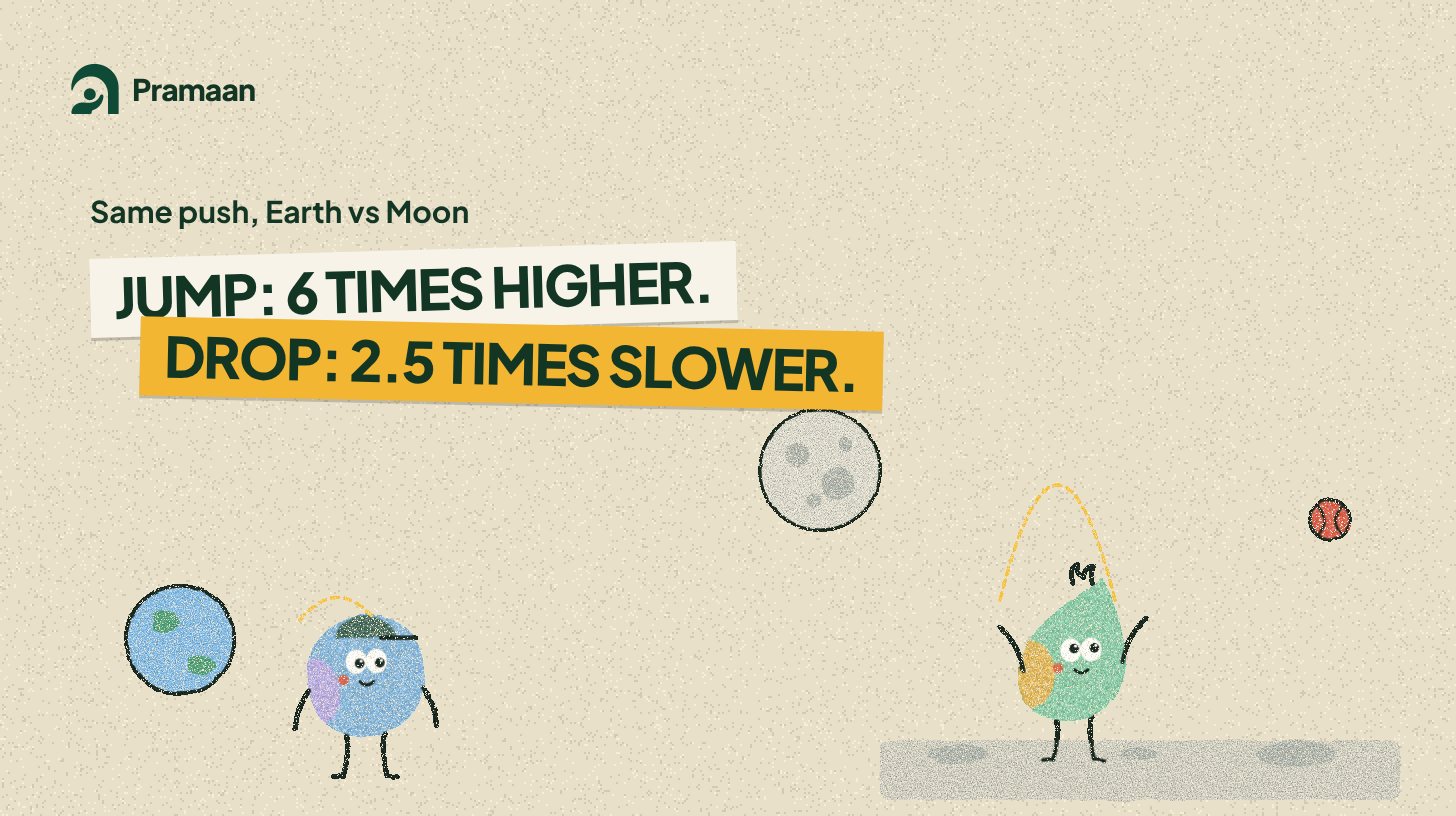
But "one-sixth gravity" does not mean everything happens six times more. Push off the ground with the same speed and:
- you rise about six times higher, because the height you reach depends on gravity directly
- you stay in the air about six times longer on the way up and back down
- but if you simply drop a ball from a fixed height, it takes only about two and a half times longer to land, because fall time depends on the square root of gravity
That third line catches most adults, and a sport's rules have to account for it. A ball kicked high gives a Moon goalkeeper about six times the usual time to get under it. A ball that simply falls from a height gives only about two and a half times.
Fact two: almost no air
The same fact sheet estimates the total mass of the Moon's atmosphere at about 25,000 kilograms, spread over an entire world. For a sport, that is effectively none.
No air changes more than people expect:
- Nothing curves. A cricket ball swings and a football bends because air pushes unevenly on a spinning or seamed ball. On the Moon, every throw follows a clean arc.
- Nothing slows down in flight. On Earth, air takes a large share of a long throw's distance. On the Moon it takes none, so balls go even farther than the gravity numbers alone suggest.
- Nobody hears the whistle. Sound needs air to travel. A referee would need radios, lights or a signal you can feel through the ground.
Put the two facts together and a team quickly runs into a design problem: a normal ball, thrown normally, would leave any field you could reasonably build. Do you make the field enormous, slow the ball down, or change what counts as a score? There is no single right answer, and teams have to argue their way to one.
A real research twist: running on the walls
Low gravity is not only a problem for games. Alberto Minetti, a physiologist at the University of Milan, has spent years studying how people walk and run in reduced gravity. In a 2024 paper in Royal Society Open Science, he and his colleagues asked whether settlers on the Moon could keep their muscles and bones in shape by running horizontally around the inside of a circular wall, the way motorcyclists ride a fairground "wall of death". Running fast enough around a curve presses you into the wall, giving the body a load that weak lunar gravity cannot.
To test the idea on Earth, the team rented a wall of death, removed its roof and used a crane, a harness and bungee cords to make two volunteers feel about one-sixth of their body weight. After five to eight attempts, both could run around the wall unassisted.
The limits matter. Two people is a demonstration, not a trial. The low gravity was simulated, and the paper proposes running as a countermeasure for bone and muscle loss rather than proving it works. Still, it hands a team a genuinely new idea: maybe the best Moon sport is played on the walls, not the floor.
Why a made-up sport is serious work
Inventing a Moon sport looks like play. Underneath, it asks a child to hold physics, arithmetic and design in their head at once: what the numbers say, what a fair rule looks like, and what people would actually want to watch. Every rule has to survive a "why?" from a teammate.
It also teaches something harder to name. Shepard was an expert, and his gut was off by a long way. A problem where intuition fails is where children learn to check their guesses against evidence instead of defending them.
Sources
- NASA Space Science Data Coordinated Archive, Moon Fact Sheet (surface gravity 1.62 m/s², ratio 0.165; atmosphere about 25,000 kg)
- Minetti et al., University of Milan, Horizontal running inside circular walls of Moon settlements, Royal Society Open Science, 2024 (2 participants)
- Universe Today, Lunar explorers could run to create artificial gravity for themselves, 1 May 2024
- CNN, Remastered image reveals Alan Shepard's Moon golf shot went about 40 yards, 2 Dec 2022